Inclusive workplaces boost productivity by 30% Learn How
Partner With Us
Flag IN
IN
USA
UK

Risks associated with Employee Assistance Programs

Table of Contents

Author

Kelp

Risks Associated with EAP

Risk-awareness and mitigation strategies for successful implementation of EAPs

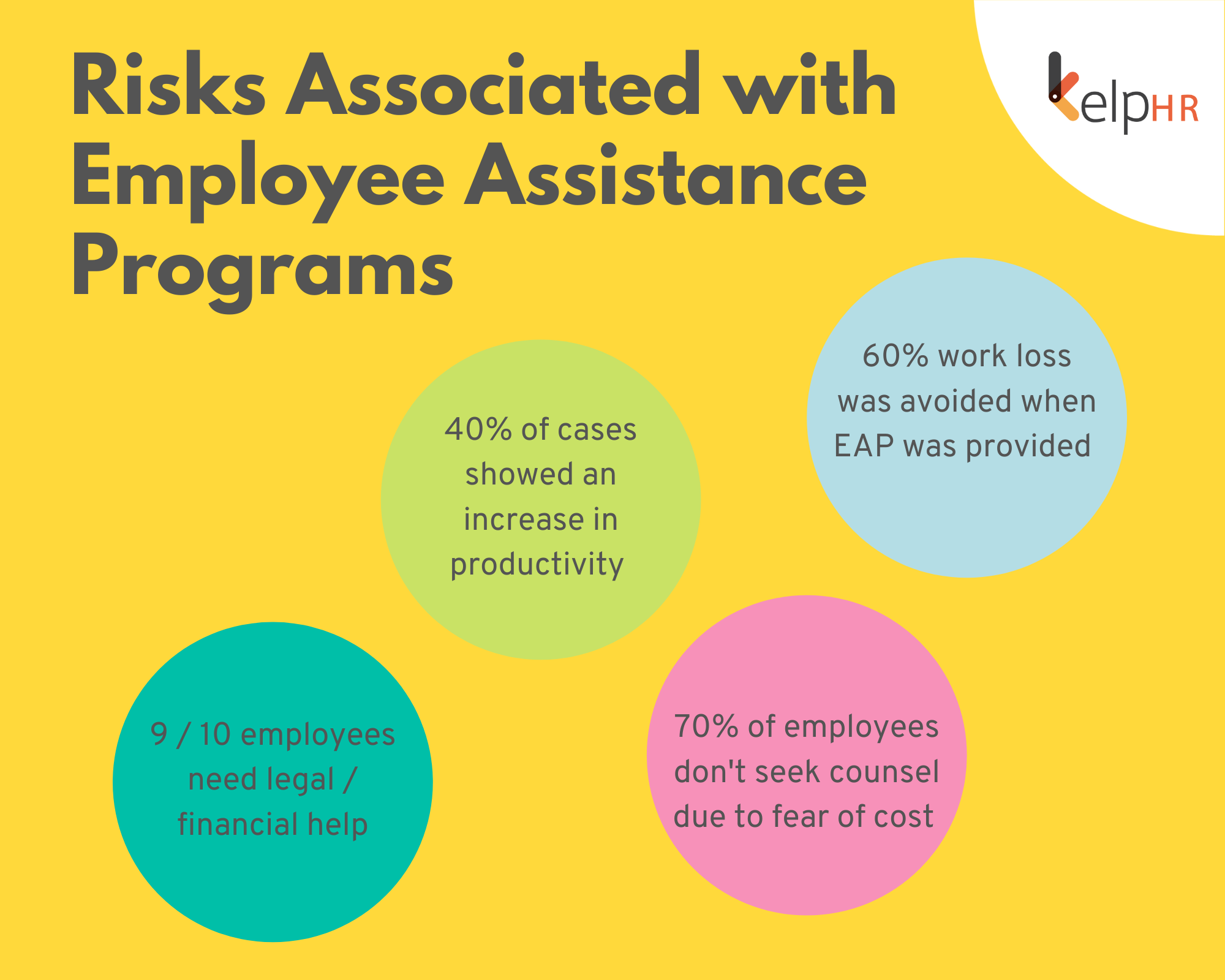
EAPs are undoubtedly good for our employees and the organisation. However they do carry inherent risks. Knowing what these are and having a plan to mitigate them is part of ensuring that the EAP is a success. Here are the points to consider:

Lack of Use

In spite of all the efforts from the HR’s side to provide suitable EAP services, employees might not avail them, defeating the purpose of establishing an EAP in the first place. This may be due to stigma or lack of time or other reasons.

Mitigation Strategy:

Spreading awareness to break the stigma, constantly reassuring employees that the EAP is implemented in their best interests and ensuring that there is no breach of confidentiality, except in extreme cases, are the ways to increase usage. This takes time and patience.

Poor Services

The EAP vendor may not provide quality services, as promised at the time of signing the contract, or they may deteriorate over time. The vendor’s employees can get replaced with inadequately qualified personnel causing a drop in the standard. Certain services may be abruptly cut off.

Mitigation Strategy:

A constant check must be maintained by the HR on the quality of services. This can be done by keeping in touch with the vendor and seeking feedback from employees. The HR team must also be open to supporting the vendor or employees within the scope of their responsibilities to maintain the quality and availability of services.

Cost angle

The cost of the services might exceed the value derived from such services. This might not happen immediately or at the beginning but can creep in slowly, making it difficult to spot. It can hurt the profitability while not being sufficiently beneficial to the employees and the organisation.

Mitigation Strategy:

A cost-benefit analysis must be performed periodically. The HR must collaborate with the Finance team to understand the cost and fund-flow impact of the EAP and come up with measures to maximise the utility of the services.

Distraction

EAP related activities might distract employees from their official work. They might tend to focus on resolving their non-work-related issues when they are supposed to be working on their deliverables, which may be counterproductive.

Mitigation Strategy:

The scope, timing and duration of EAP services must be well-defined from the very beginning, with the exception of emergencies. Adherence to these policies must be emphasised so that employees do not lose sight of their professional duties.

Redundancy

The reasons for which certain EAP services were introduced may not exist after a point of time. This will hurt the organisation financially and cause additional administrative work that does not benefit the employees. The gamut of services that are offered by the vendor may not be relevant to employees.

Mitigation Strategy:

The HR must obtain timely and periodical feedback from employees on whether or not the EAP services are relevant and useful. Care must be taken to ensure that the spectrum of services caters to most, if not all, employees.
Understanding these risks and following the mitigation strategies while implementing an EAP will ensure that the organisation and its employees are protected in the face of adversity. 

Recent Posts

Categories

Calendar Icon Events
Close

Event Calendar

JUNE 2026

MO
TU
WE
TH
FR
SA
SU
1
2
3
4
5
6
7
8
9
10
11
12
13
14
15
16
17
18
19
20
21
22
23
24
25
26
27
28
29
30

Head – Client Relations

Gomathi Venkatasubramanian is a seasoned client relations and strategy leader with over nine years of experience in sales, client engagement, and conflict resolution. As the Head of Client Relations, Gomathi and her team ensure that every Kelp client enjoys excellence in service delivery and engagement.  With her vast product knowledge, Gomathi takes pride in being able to go beyond the call to action and provide innovative solutions and services to clients that align with their people and business goals.

Prior to Kelp, Gomathi worked with organizations across the sales and presales cycles thereby acquiring a deep understanding of the process and how to shift from a sales to a solutions mindset.  That has helped her in honing her unique style in building client relations and trust.

Beyond her professional pursuits, Gomathi enjoys traveling and exploring new destinations, embracing different cultures and perspectives. She also finds solace in Indian music, which serves as a source of relaxation and inspiration.


Navneet Chugh

Director & Entrepreneur

Navneet, Managing Partner of Chugh LLP, offers global legal and tax services with 575 employees. An Attorney, CPA, and MBA from USC, he founded SABA and TiE Southern California and serves on multiple boards globally.

Bhaskaran MR

Director & Entrepreneur

Baskaran Rajaraman is an entrepreneur with interests in real estate, healthcare, and eCommerce. He has previously consulted with Krossark, Citrisys, Booz Allen, and Hamilton, and Polaris on BFSI, eCommerce, and logistics.

Manju Manocha

Head - Business Development

Manju, Head of Business Development at Kelp, drives sales strategy and growth. An HR expert with a master’s in Personnel Management, she has worked with Mphasis, BMC, Syntel, and WNS.

Smita Mukharjee

Head – DEI Center of Excellence

Smita is a dynamic and experienced DEI and Learning Consultant with a unique blend of academic expertise and practical application. With an MBA from the University of Mumbai and an M.Phil from the esteemed Tata Institute of Social Sciences, she is currently pursuing a PhD.

Smita brings with her over a decade and a half of experience across both academia and corporate training and has helped shape the learning journeys of professionals across industries. Her expertise spans human behaviour, training and development, research, and organizational diagnostics. Smita’s research has been showcased at prestigious institutions, including IIM Indore, IIM Bangalore, IIM Trichy, and Nirma University..

Passionate about fostering diversity and inclusion, Smita brings an engaging approach to training, blending research-driven insights with interactive methodologies. Beyond her professional commitments, she enjoys exploring new cultures and perspectives through travel, always seeking to broaden her understanding of the world.

Shalu Salwan

Chief Operating Officer

Shalu, an MBA from ISB, leads operations and product development at Kelp, focusing on efficiency and impact. Passionate about L&D, DEI, and PoSH, she thrives on adventure—whether scaling mountains or exploring the ocean.

Elango R

Global Leader

Elango, Global CHRO and Business Head at MphasiS, grew the company from $12 million to over a billion. He led key integrations, integrated CSR practices, and has held leadership roles at Raheja Group, UB Group, and Bank of America.

Rangan Mohan

Veteran Executive Coach

Rangan Mohan, an executive coach with 30 years of experience, has held CEO roles at MphasiS and Hinduja Global Solutions. A graduate of Madras University and IIM Ahmedabad, he is now a director and consultant.

Deepa Padmanaban

Head – Learning Solutions and PoSH Center of Excellence

Deepa, an MBA and Certified PoSH trainer, excels in client experience and HR. At Kelp, she fosters inclusivity through collaboration. Passionate about singing and voice artistry, she also announces for All India Radio.