IN
IN

 USA
USA
 CA
CA
 IN
IN
A note arrives in the IC’s inbox. No name at the bottom. No department is listed. Just a specific allegation: a senior manager in a particular team has been making unwelcome physical advances toward a junior colleague. Enough detail to be credible. Not enough detail to act under the statute.
The Presiding Officer reads it twice. Then calls the external member. The question on the table is one that IC members across India encounter regularly, and that almost no training programme prepares them for: what do we do with this?
Ignoring it feels being irresponsible. A person went to the effort of writing it down, and the allegation, if true, describes a serious violation. But acting on it without a named complainant raises a different set of problems: procedural, legal, and constitutional. The PoSH Act does not hand out IC members with a clear answer. It is entirely silent on anonymous complaints
That silence is the subject of this piece. And it is precisely what Kelp and ILA will be unpacking in our session on 27th August 2026: “Handling Anonymous and Informal Complaints Under PoSH.”
What does the Act Actually Say (and What It Does Not)
Section 9 of the Sexual Harassment of Women at Workplace (Prevention, Prohibition and Redressal) Act, 2013 sets out the complaint mechanism. It requires a written complaint from the aggrieved woman, filed within three months of the incident (or three months from the last incident in a series of incidents). Where the woman is unable to file due to physical or mental incapacity, the complaint may be filed by a relative, friend, co-worker, or any person with her written consent.
The Act says nothing about anonymous complaints. It does not explicitly prohibit them. But it also provides no procedural pathway for the IC to act on one. Section 11, which governs the inquiry process, flows from a valid complaint under Section 9. Rule 7(4) of the PoSH Rules requires the IC to conduct inquiries in accordance with the Principles of Natural Justice, which include the respondent’s right to know the allegations, know who has made them, and have a reasonable opportunity to respond.
The combined reading is clear: the IC’s formal inquiry jurisdiction is triggered by a written, identified complaint. Without a named complainant, the statutory process cannot begin.
What Have the Courts Said
Judicial decisions have reinforced this position, most directly in Manjeet Singh vs. Indraprastha Gas Limited, where the Delhi High Court set aside an IC’s findings on the grounds that the complaint had been anonymous. The court noted that anonymous complaints cannot be acknowledged or acted upon unless submitted in writing with the complainant’s identity, and that investigating alleged harassment based on anonymity could present fundamental challenges to procedural fairness.
The Gujarat High Court addressed a related question in Dipakkumar Dineshbhai Luhar vs. State of Gujarat (2023), where an accused challenged a departmental inquiry initiated based on an anonymous complaint. The petitioner argued that the charge sheet was void because it rested on a complaint with no identified complainant, and the court examined this against the PoSH Act’s own requirements under Section 9.
The Aureliano Fernandes ruling (2023) and the more recent Dr. Sohail Malik vs. Union of India (2025) judgment did not directly address anonymity, but both reinforced the broader principle that IC proceedings must comply with Principles of Natural Justice: notice of charges, fair hearing, and a reasonable opportunity to respond. These protections become procedurally impossible when the IC does not know who made the complaint, because the respondent cannot meaningfully respond to an allegation from an unidentified source.
Can an IC Simply Do Nothing?
This is where the conversation gets more nuanced than “anonymous complaints are invalid” and where most legal analysis stops too early.
The IC cannot launch a formal inquiry under Section 11 on the basis of an anonymous complaint. That much is settled. But the Act does not exist in isolation. Section 19 places a separate, affirmative obligation on the employer to provide a safe working environment and to take all steps necessary to prevent sexual harassment. That obligation does not depend on receiving a formal complaint. It is a standing duty.
This creates a space, not for the IC to investigate anonymously, but for the employer to treat the information as an organizational signal and act within its broader governance framework.
Here is how that works in practice.
The IC can acknowledge receipt and invite the complainant to come forward. If the anonymous complaint was submitted via email, the IC can reply to that email address, explaining that a formal inquiry requires a written, identified complaint under Section 9 and assuring the person of confidentiality protections under Section 16 of the Act. The goal is not to pressure disclosure but to remove the fear barrier by making the process transparent.
The employer can initiate a preliminary fact-check outside the PoSH framework. This is not an IC inquiry. It is an employer acting on its Section 19 duty to maintain a safe workplace. If an anonymous report contains specific, verifiable details (a named respondent, a particular location, a timeframe), the employer’s HR function can quietly verify whether the pattern described is consistent with other data: previous complaints, exit interview themes, team-level attrition, or feedback from skip-level conversations. This fact-check does not replace a formal IC inquiry. It builds a picture of whether the concern has substance and whether other affected individuals exist who might choose to file formally.
The employer can increase preventive measures around the area of concern. This might mean conducting a scheduled awareness session for the team in question, conducting a dip stick or surveys, reinforcing reporting channels, or ensuring the IC’s contact details are visibly displayed, and the complaint process is widely understood. These steps are within the employer’s Section 19 mandate and require no formal complaint at all.
The IC should document an anonymous complaint and its response. Even though a formal inquiry cannot be initiated, the complaint and the steps taken should be recorded in the IC’s files. If a formal complaint from an identified individual later emerges about the same respondent, the documented pattern of prior anonymous reports becomes relevant in context.
The Informal Complaint: A Different Question
Anonymous complaints are often conflated with informal complaints, but they are not the same thing. An informal complaint is one where the complainant’s identity is known, but she has not yet submitted a written complaint under Section 9, perhaps because she wants the behaviour to stop without a formal inquiry, or because she is still deciding whether to proceed.
The Act does not use the word “informal,” but Section 10 provides for conciliation at the request of the aggrieved woman before a formal inquiry begins. This suggests the Act contemplates a phase where the complainant has come forward but has not yet committed to a full inquiry process.
In practice, many IC members encounter situations where a colleague approaches them in the corridor or sends a message saying, “I want to tell you something, but I’m not sure I want to file a complaint.” How the IC handles that moment matters enormously. The correct response is not to push for immediate formalization or to dismiss the approach because no written complaint has been received. It is to listen, explain the process including confidentiality protections, outline the options available, and let the individual make an informed decision about the next steps.
What the IC cannot do is take it upon itself to launch a formal inquiry in the absence of a written complaint. The complaint mechanism under Section 9 is not a formality the IC can waive for convenience. It is a procedural safeguard that protects both the complainant’s agency and the respondent’s right to due process.
The Whistleblower Policy Bridge
Many organisations already have whistleblowers or ethics hotline mechanisms that accept anonymous reports. These policies operate outside the PoSH Act’s framework, and that is precisely what gives them flexibility.
An anonymous report received through a whistleblower channel can be treated as an organizational intelligence input. The employer can investigate under its general code of conduct, misconduct policy, or service rules, none of which have the same procedural requirements as Section 9. If that investigation reveals substantive findings, the employer can take disciplinary action under its service rules or encourage the affected individual, once identified, to file a formal PoSH complaint.
The key is to keep these tracks separately and clearly documented. An investigation under a whistleblower policy is not a PoSH inquiry. The IC’s jurisdiction is preserved for when a formal, identified complaint is received. Conflating the two creates procedural vulnerabilities that a respondent can challenge in court.
What IC Members Actually Need to Know?
The honest summary is this: the PoSH Act gives the IC a powerful but specifically scoped mandate. Its formal inquiry powers activate upon receipt of a written complaint from an identified aggrieved woman. That scope cannot be stretched to cover anonymous complaints without undermining the principles of natural justice that give IC findings their legal weight.
But the employer’s obligations are broader than the IC’s. Section 19 creates a preventive and protective duty that does not depend on a formal complaint. The right response to an anonymous report is not paralysis and not a full inquiry. It is a calibrated set of actions that acknowledges the information, preserves procedural integrity, and creates conditions for a formal complaint to be filed safely.
This is the kind of judgment call that cannot be learned from a single reading of the statute. It requires IC members who understand both the legal boundaries and the human dynamics of reporting, and who can hold both simultaneously without defaulting to either rigid proceduralism or well-intentioned overreach.
That balance is exactly what we will be working through in the Kelp x ILA session on 27th August 2026. If your IC has ever received an anonymous tip, an informal approach, or a complaint that does not quite fit the Section 9 template, this session is built for you.
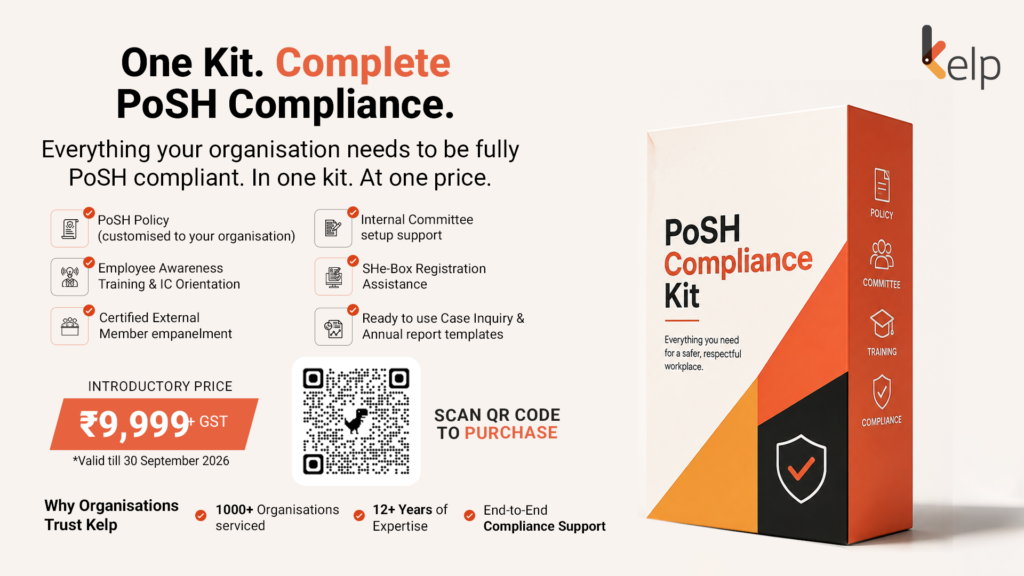
Ready-to-use PoSH Compliance Kit for MSME’s and smaller companies
If you’re a small organisation trying to implement PoSH compliance without an HR team or the necessary resources, we’ve made it simpler. Our PoSH Compliance Kit brings together everything you need in one ready-to-use package – so you can put the right processes in place without starting from scratch.
Get your PoSH Compliance Kit – Buy now