IN
IN

 USA
USA
 CA
CA
 IN
IN
It is a question that HR teams across India are asking more frequently and answering incorrectly more often than they realise. An employee comes forward with a complaint. The conduct described is serious. The person complaining is a gay man, or a transgender woman, or a non-binary employee. The HR manager checks the PoSH policy. It says aggrieved woman. A quiet panic sets in. Does the Internal Committee have jurisdiction here? Is this even covered? What does the law actually say?
The answer is more complicated and more important than most compliance checklists acknowledge. This blog maps the legal terrain honestly, including where the law protects LGBTQ+ employees, where it does not, and what employers are legally and practically required to do in the gaps.
What the PoSH Act Actually Says
The Sexual Harassment of Women at Workplace (Prevention, Prohibition and Redressal) Act, 2013 was enacted to address a specific and documented gap in workplace safety for women. Its definitions are deliberate and bounded.
The Act defines an “aggrieved woman” as the complainant and this definition, as written, covers women. The Act’s definition of “sexual harassment” is framed around conduct directed at a woman. The Internal Committee’s mandate under the Act is to receive, investigate, and redress complaints from aggrieved women.
The plain reading of the statute is unambiguous: as a matter of law, the PoSH Act does not extend its protections to gay men, lesbian women filing complaints against women respondents in all configurations, non-binary individuals, or transgender persons in every circumstance. This is not a legal grey area open to creative interpretation. It is an explicit structural feature of the Act one that the Supreme Court of India has confirmed.
The Supreme Court’s 2023 Ruling: What It Said and Why It Matters
In November 2023, in Binu Tamta & Anr. v. High Court of Delhi & Ors., the Supreme Court of India declined a petition seeking to amend the Gender Sensitization and Sexual Harassment Regulations to expand the definition of “aggrieved woman” to include LGBTQIA+ individuals.
The Court reasoned that the Act’s definition of “aggrieved woman” does not apply to LGBTQIA+ individuals, and that broadening the Act’s scope could detract from its primary focus preventing sexual harassment of women. The petition was dismissed.
This ruling is significant for two reasons. First, it closes the interpretive door that some progressive employers had hoped would allow ICs to voluntarily extend PoSH protections to all employees under the existing statute. Second and the Oxford Human Rights Hub noted this the decision has the concerning potential to instil hesitancy among LGBTQIA+ individuals when reporting instances of workplace sexual harassment, even where some protection might theoretically exist. The law, as interpreted by India’s highest court, does not protect LGBTQ+ employees under the PoSH Act.
Where Some Protection Does Exist: The Transgender Persons Act
The legal picture is not entirely absent of protections. For transgender employees specifically, there is statutory ground.
The Transgender Persons (Protection of Rights) Act, 2019 which came into force in January 2020 prohibits both public and private establishments from discriminating against transgender persons in employment. This prohibition covers recruitment, promotions, benefits, and infrastructure adjustments. Every establishment is mandated to adopt an equal opportunity policy for transgender persons and to designate a complaint officer to investigate violations.
This is a binding legal obligation. If your organisation employs any person who is transgender or could employ one you are required by statute to have an equal opportunity policy in place and a designated complaint officer to handle grievances.
In 2025, the Supreme Court went further. In Jane Kaushik v. Union of India (2025 INSC 1248), the Court held that employers who fail to safeguard transgender employees are guilty of what it termed “omissive discrimination” discrimination through inaction, not just through active conduct. The Court’s Advisory Committee, led by Justice Asha Menon, developed an Equal Opportunity Policy framework and made reasonable accommodation a constitutional requirement rather than a matter of organisational discretion.
In March 2026, the Transgender Persons (Protection of Rights) Amendment Act, 2026 received Presidential assent, introducing revised procedures for legal gender recognition and identity certificate issuance. While the Amendment has faced criticism and Supreme Court scrutiny, it signals continued legislative attention to this space.
What the Transgender Persons Act does not provide is a detailed mechanism for sexual harassment complaints. It creates a complaint officer requirement but does not prescribe an equivalent of the PoSH inquiry framework. That structural absence is itself a problem.
The Gap That Remains
Take stock of where this leaves the Indian employer:
- A gay employee harassed by a colleague: No PoSH Act protection. No equivalent statute. No mandatory complaint mechanism under any current law.
- A lesbian employee harassed by a female colleague: PoSH Act protections apply, as the complainant is an “aggrieved woman.” The Act’s gender of the respondent is not restricted.
- A transgender woman harassed at work: May have recourse under PoSH depending on judicial interpretation in specific cases, and has recourse under the Transgender Persons Act’s complaint officer mechanism but no clear, uniform process.
- A bisexual employee harassed in a same-sex context: Depends entirely on the gender of the complainant and the specific configuration of the alleged conduct.
- A non-binary employee: No statutory protection under either law in clear terms.
A Glassdoor-commissioned survey reported that 55% of LGBTQ+ employees in India had experienced or witnessed anti-LGBTQ+ comments by colleagues. The legal framework provides remedies for a fraction of those employees, in some circumstances, through mechanisms that were not designed with them in mind. This is the gap.
What Employers Are Legally Required to Do (Regardless of the Gap)
Even within the current legal landscape, employer obligations are more extensive than many compliance teams recognise.
Under the PoSH Act:
- Constitute a valid Internal Committee with an external member and a presiding senior woman officer
- Conduct annual training for all employees on PoSH this includes awareness of what constitutes harassment and how to access the IC
- Submit an annual report to the District Officer
Under the Transgender Persons Act, 2019:
- Adopt and implement an Equal Opportunity Policy specifically for transgender persons this is not optional
- Designate a Complaint Officer to receive and investigate complaints related to discrimination against transgender employees
- Ensure non-discrimination in recruitment, promotion, and benefits on grounds of gender identity
Under constitutional principles (NALSA v. Union of India, 2014; Navtej Singh Johar, 2018; Jane Kaushik, 2025):
- Discrimination based on gender identity and sexual orientation has been recognised as constitutionally impermissible by the Supreme Court in multiple judgments
- Employers cannot rely on the absence of explicit statute to justify discriminatory practices constitutional rights do not require legislative intermediaries to be operative
- Jane Kaushik specifically established that failing to protect transgender employees amounts to omissive discrimination a concept that has implications for how courts will assess employer liability even where no explicit statutory provision exists
The Anti-Discrimination and Equality Bill, 2016 which would have provided comprehensive protections against employment discrimination on grounds of sexual orientation and gender identity lapsed with the dissolution of the Lok Sabha in 2019. No equivalent legislation has been introduced since. The legislative vacuum is real.
But the constitutional obligations are not.
What Responsible Employers Are Doing: The Voluntary Standard
In the absence of complete statutory coverage, leading Indian organisations are taking matters into their own hands and setting a voluntary standard that is increasingly the expectation rather than the exception.
- Gender-neutral internal harassment policies replace “aggrieved woman” with “aggrieved employee,” explicitly extend the IC’s jurisdiction to complaints of harassment regardless of the complainant’s gender identity or sexual orientation, and define prohibited conduct to include harassment based on sexual orientation, gender identity, and gender expression. The IC’s mandate is widened by internal policy design, not by statute.
- Same-sex partner benefits extend health insurance, group mediclaim, leave entitlements, and other family benefits to same-sex domestic partners — not just legally married spouses. Organisations including Infosys have extended this to cover gender-affirming medical procedures. Wipro has published explicit commitments to apply its own non-discrimination standards in the absence of local laws.
- Designated complaint mechanisms go beyond the Transgender Persons Act’s complaint officer requirement to create an integrated grievance mechanism for all LGBTQ+ employees accessible, confidential, and backed by a clear investigation process.
- Manager sensitisation training covers pronoun usage, responding to disclosure, handling third-party homophobia and transphobia, and recognising the forms of exclusion that LGBTQ+ employees navigate daily but that never rise to the level of a formal complaint.
- Employee Resource Groups for LGBTQ+ employees and allies with executive sponsorship, a budget, and a formal channel to influence policy create a structural voice for communities that have no statutory advocate.
A Note on the BNS and Criminal Law
With the Bharatiya Nyaya Sanhita, 2023 replacing the Indian Penal Code from 1 July 2024, it is worth noting that Section 75 of the BNS criminalises sexual harassment defined as physical contact and advances, demanding or requesting sexual favours, showing pornography against a person’s will, and making sexually coloured remarks. The provision is gender-neutral in its framing: it protects persons, not specifically women.
This means that where conduct against an LGBTQ+ employee constitutes criminal sexual harassment under Section 75 of the BNS, there is a criminal law avenue available to them even if the PoSH Act’s civil and quasi-judicial mechanisms are not. This is an important but limited protection: criminal prosecution is a fundamentally different process from a PoSH inquiry, and the threshold, burden of proof, and practical access barriers are substantially different.
The BNS provision does not substitute for a robust internal complaint mechanism. It is a background legal framework, not a replacement for workplace policy.
Where Kelp Can Help
The legal landscape around LGBTQ+ inclusion at work in India is evolving and the gap between what the law requires and what it provides is significant enough that employers cannot afford to wait for legislative clarity.
At Kelp, we work with organisations to close that gap:
- Gender-neutral harassment policy design: drafting and integrating internal policies that extend protection to all employees, built on legally sound language that holds up if challenged
- IC sensitisation and training : equipping IC members to receive, assess, and investigate LGBTQ+-related harassment complaints with competence and confidentiality
- Transgender inclusion compliance : designing Equal Opportunity Policies, appointing and training Complaint Officers, and meeting the full obligations of the Transgender Persons Act
- LGBTQ+ awareness workshops : covering allyship, curiosity harassment, and what inclusive behaviour looks like in everyday workplace interactions
- PoSH advisory : end-to-end compliance support for organisations building or overhauling their PoSH framework
The law has not yet caught up to the workforce. Your organisation’s policy can.
Reach out to our team at www.kelphr.com | info@kelphr.com | 9500129652
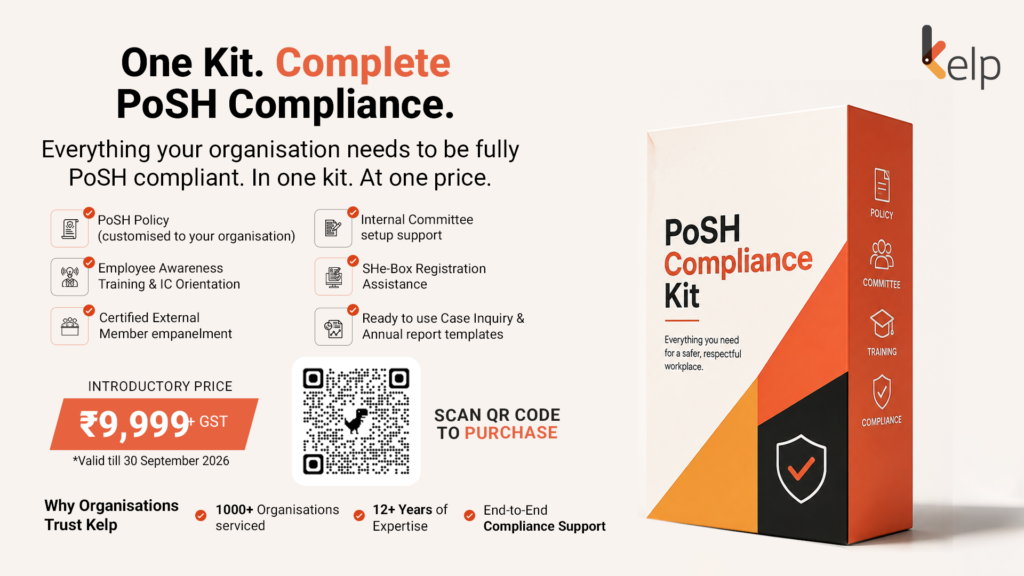
Ready-to-use PoSH Compliance Kit for MSME’s and smaller companies
If you’re a small organisation trying to implement PoSH compliance without an HR team or the necessary resources, we’ve made it simpler. Our PoSH Compliance Kit brings together everything you need in one ready-to-use package – so you can put the right processes in place without starting from scratch.
Get your PoSH Compliance Kit – Buy now