IN
IN

 USA
USA
 CA
CA
 IN
IN
- What is counselling?
Counselling refers to a process that psychologically empowers individuals to gain control on their mental health or well-being. Counselling increases self-awareness and a sense of well-being and also an understanding of the resources that he or she can use.
- When can one seek counselling?
Anyone who is struggling with a personal concern can seek counselling.
Example:
- When someone is unable to handle fear, stress, guilt, grief, sadness, loss or relationships.
- People who are unable to come out of addictions like drugs, alcohol or any other substances and
- People who want greater and in-depth self-awareness.
- What are the different forms of mental health related issues that occur commonly in a work environment?
Most common are the below:
- Depression / Mood disturbances
Indicators: An employee is generally irritable, nervous, withdrawn and had body aches and insomnia. Insomnia can lead to poor decision making or impaired judgement and poor concentration. Having angry outbursts at work, difficulty in getting along with bosses or peers.
Statistics: 6 % of the workforce population reports depression. Analysis of the WHO questionnaire reports that people who had symptoms of depression reported 27 lost days of work.
- Anxiety:
Indicators: Muscle aches, general body aches, restlessness and excess worrying, frequent headaches with no particular cause, Insomnia, gastrointestinal disorders, high blood pressure, changes in weight due to overeating or not eating enough.
- Attention Deficit Hyper Activity Disorder:
ADHD also affects adults and it manifests in employees as disorganization, difficulty in meeting deadlines, inability to manage workloads, difficulty following instructions, arguments with co workers
Statistics: Employees with ADHD lose 22 days of work every year, they are 18 times more likely to be disciplined for bad behaviour and 2 to 4 times likely to be terminated from their jobs.
- Substance Abuse Disorder:
Usage of drug or alcohol to cope with Insomnia, to help with anxiety.
- Psychotic disorder:
Schizophrenia: Schizophrenia is characterised by thoughts or experiences that seem out of touch with reality, disorganised speech or behaviour and decreased participation in daily activities are some of the indicators of this disorder. Difficulty with concentration and memory may also be present.
Delusions: A person with delusions cannot tell the difference between what is real and what is imagined. They firmly believe that it is true and this might impact the work environment. Eg; An employee may say ‘My peer next to me is trying to get me out of my job or is trying to put me down’ without any evidence.
Hallucinations: Hallucination is a perception of having seen, heard, touched, tasted or smelled something that wasn’t actually there. For example, you might hear a voice that no one else in the room can hear or see an image that isn’t real.
Paranoia: Paranoia is an unrealistic distrust of others or a feeling of being persecuted. Extreme degrees may be a sign of mental illness. Eg; the feeling that you’re being threatened in some way, such as people watching you or acting against you, even though there’s no proof that it’s true.
Eating disorder:
Anorexia Nervosa: A disorder causing people to obsess about weight and what they eat.
Bulemia Nervosa: A disorder caused by a person eating large quantities, but finally throws up.
Binge Eating: A disorder caused by a person eating large quantity of food uncontrollably and with a feeling of guilt. It happens periodically.
- Any online Assessments that the Audience can quickly to do check their mental and emotional well-being?
A mental health assessment gives your doctor a complete picture of your emotional state. It also looks at how well you are able to think, reason, and remember (cognitive functioning). There are online self-assessments resources available on the internet. But first check with the counsellor and then do this. It is always better for the counsellor to do the assessment first as these tools may create or increase negative feelings.
- What are the signs and symptoms that a Manager or HR or colleagues can watch out for in Employees to direct them to seek Help?
Some pointers that the Manager and HR or colleagues can look out for is
- Interaction: Is he/she withdrawing from usual interactions with people around him / her?
- Appearance: Is he or she not dressed up properly?
- Presenteeism: A major problem that organizations face today is not absenteeism. It is Presenteeism. Presenteeism occurs when ongoing physical and/or mental health conditions prevent employees from being fully productive at work. … In cases of presenteeism, team members want to give their best efforts but cannot deliver because of health issues or personal problems and they could spread it to others as well./span>
- Moods: Is the person hawving extremes of changes in moods at the workplace? Is he or she having arguments at the workplace?
- Anxiety: Is the person restless or has excessive worrying?
- In Progressive nations, seeking the help of a counsellor is a very common thing? Is it still a taboo here? How can we over-come this?
Counselling even today in most regions of India is considered as a taboo and people don’t understand the concept of mental illness. It is either lack of awareness, fear or a matter of shame for people who do not want to seek counselling guidance as a treatment method for their mental illness.
Organizations can sensitize their employees on counselling during floor walks. This is what was followed by one of the organizations where Kannan was the counsellor.
- What are the benefits an organization will reap by having an Employee Assistance Program?
Some important benefits that Organizations can reap from Employee Assistance Program could be:
- Building a positive work environment for everyone by providing support to mental health of employees
- Can reduce number sick leaves and increase productivity of an organizations.
- Timely redress of issues regarding mental wellbeing and avoiding that to manifest as heath issues.
- Reduced healthcare costs of organization by preventing serious issues.
- Are there any laws in India related to Counselling/Mental health?
There are no specific laws for counselling. The Mental Healthcare Act (MHCA), 2017, is enacted with an aim to promote and protect the rights of and improve the care and treatment for people affected by mental illness. It ensures that these persons have a right to live life with dignity by not being discriminated against or harassed.
There are a few Act that have embedded counselling as a part.
The Protection of Children from Sexual Offences (POCSO) Act, 2012 – The role of Counsellors and the Counselling of the abused child and their family is spelt out
Sexual Harassment of Women at Workplace (Prevention, Prohibition and Redressal) Act, 2013 – The Act specifies certain Recommendations that can be given by the organization’s Internal Committee in the absence of service rules and counselling is one of them.
The Rehabilitation Council of India Act 1992 – The Act specifies the requirement of professionals who can be Rehabilitation and Vocational Counsellors.
- What are some of the tips for HR on how to choose their counsellor?
The following factors should be considered while choosing your counsellors:
Experience of the Counsellor: If the counsellor has handled all kinds of mental health issues. share a little about your presenting issue and see how the therapist responds.
Confidentiality: It is very important to maintain the identity of the client during counselling
Rapport building: Is the counsellor having a sense of connection with the clients?
Continuing a therapy: The counsellor may refer the client to another counsellor in the event of
- Not able to handle a client
- the therapy not progressing well
- absence of a specific therapy required by the client with the current counsellor.
- What is the difference between Psychology and Psychiatry?
- Psychiatrists are medical doctors while psychologist are not
- Psychiatrists can prescribe medications whereas psychologist are not
- Psychiatrist look at the biology and neurochemistry that influence our behaviour and emotions
- Psychiatrist and psychologists collaborate in patient care
- What is the prevalence of mental illness in India?
Prevalence of mental disorders (Weighted Percent)
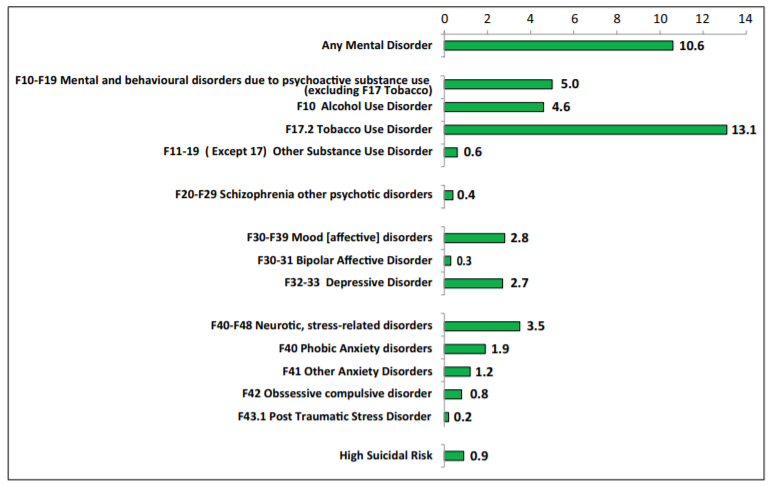
Graph taken from National Mental Health Survey of India, 2015 – 16
As per the study of National Mental Heath Survey of India, 2015 – 16, which covered entire India, incidence of mental health disorders is 10.6. Substance disorder is high India.
- Which is the age group that is affected by mental health?
As per the study of National Mental Health Survey of India, 2015 – 16, males in the age group of 30 – 49 years were the most affected. The prevalence of all disorders peak in this age group affecting work productivity, earning potential and quality of life.
Prevalence of mental morbidity in different age groups (%)
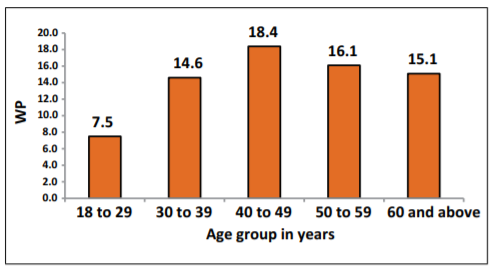
Graph taken from National Mental Health Survey of India, 2015 – 16
- Are there any differences in gender when it comes to mental health? Who gets more impacted?
Prevalence of mental disorder by gender (%)
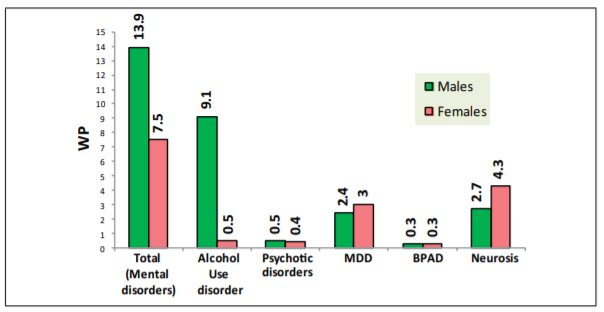
Graph taken from National Mental Health Survey of India, 2015 – 16
The total amount of illness is higher in the male population in comparison to the female population particularly Substance disorder, that is alcohol use disorder is high in men rather than women. The mood disorders and anxiety disorder which they called neurosis is high in women.
- What are the signs and symptoms that a Manager or HR or colleagues can watch out for in Employees to direct them to seek Help?
Even before it goes to the HR, the manager is in the forefront to notice any changes in the employees. Instead of stigmatising, pressurising or judging the person, the managers have to be empathetic and understand their perspective. A lot of times, there are reasons behind such behaviour. In case the employee, requires and is open to treatment, the employer has to help in providing assistance.
- What are your tips for mental and emotional well-being for people during this pandemic?
During this pandemic, there is a lot of uncertainties that we go through. Some of us are with older parents or young children. We are worried that if we step out, we are going to make things worse for the people we love. This uncertainty gets to people and it makes them anxious. At the same time, they are not in a healthy relationship to start with. When they are caught up at homes like this, domestic violence, relationship problems or sibling rivals can increase.
It is important to maintain a routine. It gives a sense of normalcy. It gives you a control on things. Do some of the things you really enjoy doing. If sometimes, it is unbearable like domestic violence, then it has to be reported to the concerned authorities.
- How to keep employees engaged and stress free, how to boost employee morale during this lockdown situation?
Employees can do the following:
- They can follow their passion and do whatever is possible indoors without stepping out.
- They can follow simple breathing exercises or muscle relaxation exercise.
- They can develop themselves by using this opportunity.
The following can be done by employers:
Employers can organise online games, or zoom parties for all employees. Some employees miss their social interactions and this will keep them engaged.