IN

 USA
 CA
 IN
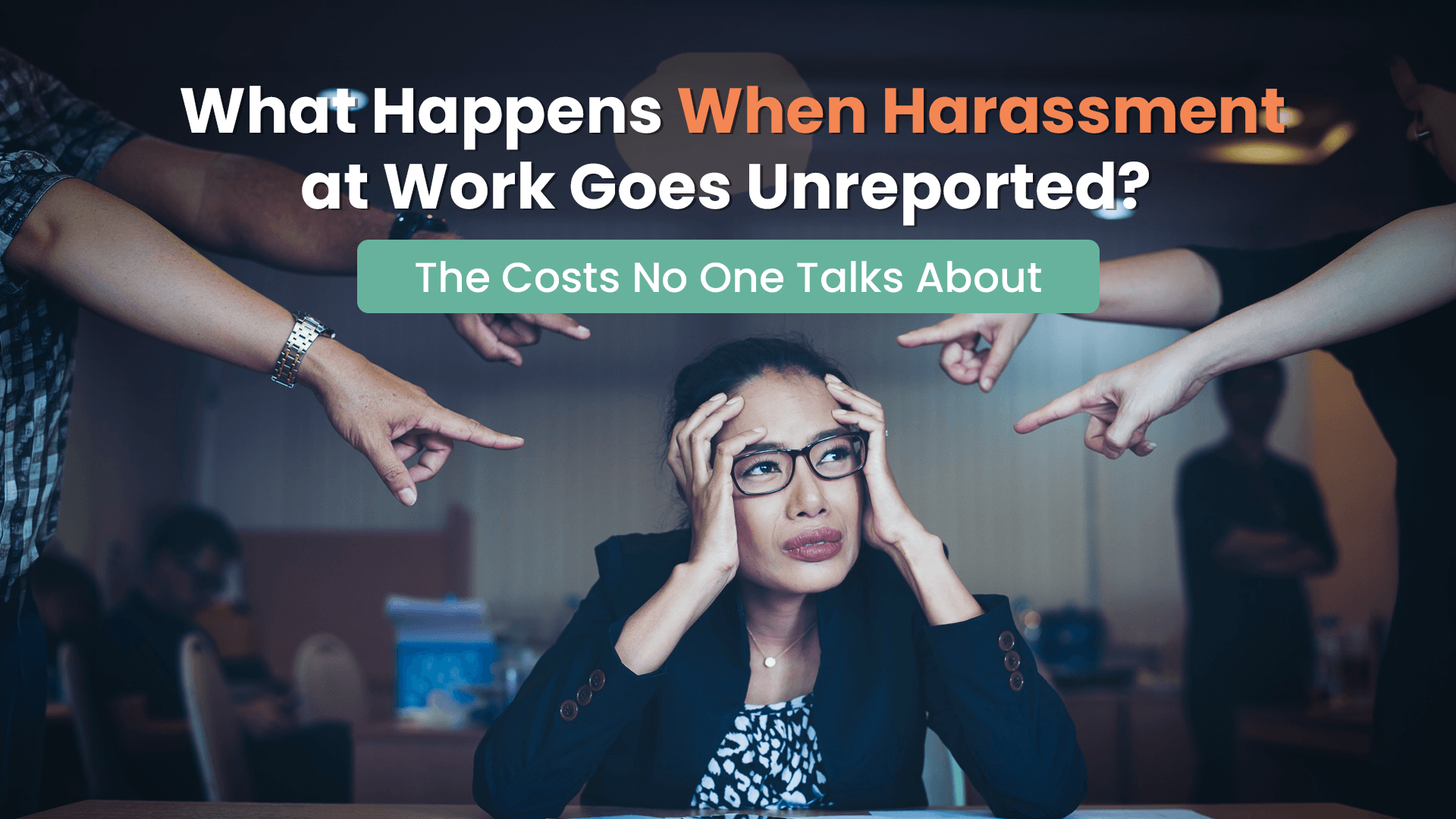
Every year, the data on workplace harassment tells the same story.
Complaints filed under PoSH represent a fraction of the incidents that actually occur. The vast majority of people who experience harassment at work do not report it. They stay quiet, they adjust, they shrink, and eventually many of them leave.
The organization, meanwhile, looks at its zero or near-zero complaint count and reads it as evidence that things are fine. This gap between what happens and what gets reported is not just a missed compliance signal. It is where real damage accumulates, quietly and consistently, in ways that show up in performance reviews, attrition numbers, sick leave records, and eventually in headlines.
what that silence costs. Not in abstract terms, but specifically: the person who experienced the harassment, the colleagues around them, and the organization that did not know, or chose not to look.
The Reporting Gap Is Larger Than Most Organizations Realize
Before getting into costs, it helps to understand how wide the gap actually is.
Studies on workplace harassment consistently find that most people who experience it do not formally report it. Research in India and globally points to a reporting rate of somewhere between 10 and 30 percent. That means for every complaint an organization receives, somewhere between three to nine incidents go unreported.
A zero-complaint record is not a clean record. It is, at best, an incomplete one. And in many cases, it is a signal that something in the workplace culture, the IC’s visibility, or the complaint process itself is discouraging people from coming forward.
Low complaint counts in a specific team often reflect low trust in the process, not low incidence. A team with no PoSH complaints filed in five years may be a genuinely safe team but a the same time It may equally be a team where no one believes anything will happen if they speak up.
Why People Do Not Report
Understanding the costs of silence starts with understanding why silence exist The reasons are consistent across research and sectors, and they are worth naming plainly.
Fear of not being believed. Harassment often happens without witnesses. It is a comment made in passing, a message sent late at night, an unwanted touch that no one else saw. The person experiencing it knows exactly what happened. They are also aware that they may not be able to prove it, and that being doubted in a formal process can feel worse than saying nothing at all.
Fear of professional consequences. In many cases, the person responsible is a manager, a senior colleague, or a client. Reporting them means risking a performance review, project reassignment, a reference letter, a promotion. The professional cost of reporting is immediate and concrete. The benefit is uncertain.
No trust in the process. If an employee does not know who is on the IC, has never been told how a complaint works, does not believe confidentiality will hold, or has watched a previous complaint be handled badly; they have entirely rational reasons to stay quiet. This explains that the process has not earned their trust.
Social dynamics. Workplaces are communities. The person who files a complaint may worry about how colleagues will respond, whether they will be labeled as difficult or whether relationships they value will change permanently. These are not irrational fears. They reflect on the real things that happen.
Not recognizing it as a harassment. Many people who experience behavior that qualifies under the PoSH Act do not name it that way. A persistent pattern of comments, unwanted attention, or quid pro quo pressure may be rationalized, minimized, or attributed to something else entirely. If someone does not believe their experience meets a formal threshold, they will not report it, even when it clearly does.
Each of these reasons is understandable. None of them makes the silence cost-free.
What It Costs the Person Who Experienced It?
The most direct and most serious cost of unreported harassment is carried out by the person who experienced it.
Research consistently links workplace harassment to anxiety, depression, reduced self-confidence, and in more serious cases, post-traumatic stress responses. When the experience goes unaddressed, these effects do not simply resolve them on their own. They compound. The person continues to work in an environment where the harassment occurred. They may continue to work with, or report to, the person responsible. Every day in that environment is a continuation of the original harm.
The physical health consequences are equally documented. Stress from carrying an unaddressed experience has measurable effects: sleep disruption, fatigue, and a reduced ability to function at full capacity. These are not vague complaints about workplace culture. They are outcomes with real costs.
Then there is the career impact, which is both the most visible and the most quietly devastating. People who experience unreported harassment often begin changing their behavior at work in ways that directly affect their professional trajectory. They avoid certain meetings. They stop contributing to forums where they previously had a strong voice. They decline projects that would bring them into contact with the person responsible. They self-limit in ways that look like disengagement from the outside but are a survival response.
And then, very often, they leave. The connection between unreported harassment and voluntary attrition is one of the most consistent findings in the research on this topic. The person leaves, gives a neutral exit interview reason, and the organization never connects the departure to what actually happened.
What It Costs the Team Around Them
Harassment does not only affect the person it is directed at. Its effects move through a team in ways that are real but difficult to trace.
Colleagues who observe or become aware of harassment and see that nothing happens absorb a clear message: this behavior is tolerated here. That message affects how safe everyone feels to raise any concern, not just a harassment complaint. A workplace that visibly tolerates harassment communicates that speaking carries risk, and people adjust accordingly. The chilling effect extends far beyond the original incident.
This is directly connected to psychological safety, which research consistently identifies as the most important factor in high-performing teams. Psychological safety is the belief that you can speak up, take risks, and raise concerns without facing punishment or humiliation. Harassment, and the organizational silence around it, is one of the most corrosive forces working against that safety.
The team-level productivity effects from following this. When trust is damaged, collaboration becomes harder. Conversations become guarded. People start spending energy managing relationships and navigating dynamics rather than doing their actual work. These costs do not show up as a line item anywhere, but they are real.
And when the person who experienced the harassment eventually leaves, their team loses their contributions, their institutional knowledge, and the working relationships they had built over time. The organization then spends on recruitment, onboarding, and the extended period before someone new reaches full productivity. None of that expense is ever attributed to the incident that set it in motion.
What It Costs the Organization
Organizations bear the full cost of unreported harassment even when they never learn about the underlying cause. The damage simply arrives under different labels.
High-performing employees who leave, citing vague reasons in exit interviews, are one face of the factors. Sustained low engagement in teams with unresolved dynamics is another. Absenteeism and presenteeism, where employees show up physically but are not functioning at capacity, are a third. None of these line items point back to their cause on their own.
The employer brand dimension is increasingly significant. Employees talk to each other and to people outside the organization. Platforms that aggregate employee experience create permanent, searchable records of how organizations handle, or fail to handle, these situations. In sectors where talent pools are small and reputations travel quickly; a known culture of harassment and silence is a direct recruiting liability.
Leadership credibility also takes a hit in ways that leaders rarely see directly. When a team watches behavior, they know is harmful go unaddressed; they draw conclusions about whether management is aware, whether management cares, and whether they can trust leadership to act fairly on anything. These conclusions affect how much discretionary effort people bring to their work, how long they stay, and whether they speak up about anything at all going forward.
The Hidden Legal Exposure
The legal exposure from unreported harassment is real and often misunderstood.
Under the PoSH Act, an employer’s obligation is not simply to constitute an Internal Committee . The Act requires employers to create a safe workplace, which includes conducting regular awareness training, maintaining a functioning IC, and taking proactive steps to prevent harassment. An organization that has done none of these things, and later faces a complaint or a regulatory inquiry, cannot point to a clean complaint record as evidence of compliance.
A pattern of unreported harassment that later surfaces, through a former employee, a media account, or a government inspection, creates a situation where the organization cannot demonstrate that it took its obligations seriously. The absence of complaints does not prove the absence of incidents. In a legal or regulatory context, it may instead raise the question of whether the organization created conditions where reporting was possible at all.
What Changes When Reporting Becomes Possible?
It is worth being clear that a high complaint count is not a sign of a broken workplace. It is often a sign of a functional one.
An organization where employees trust the IC enough to file complaints is an organization where the mechanism is working. Where confidentiality is believed. Where people think something will actually happen. A single year where complaints increase may reflect better awareness, a more visible IC, improved training, or a specific incident that was handled visibly and well.
The goal is not to minimize complaints by discouraging reporting. The goal is to address the underlying behavior and build the kind of environment where people believe that speaking up is worth it.
The practical levers for that are not complicated, even if they require sustained attention. An IC that is visible, trained, and accessible. An awareness session that employees actually attend and remember. A complaint process that is explained clearly and simply, not buried in a policy document. A history, even if small, of complaints being taken seriously.
Each of these changes the calculation for someone deciding whether to report. And that calculation, made privately by individuals across the organization, is what determines whether the costs described in this post accumulate or are interrupted.
The Question Worth Asking This Month
October is a good time for this question, sitting at the start of the review quarter before the year closes.
If the people in your organization who have experienced harassment in the past twelve months did not report it, do you know why? Do you know whether they trusted the IC? Whether they knew it existed? Whether they believed the process would protect them? The honest answer, for most organizations, is no. And that no is where the review work begins.
Kelp works with organizations across India on PoSH training, IC strengthening, and building the kind of compliance culture where reporting is actually possible. If your organization wants to close the gap between what happens and what surfaces, reach out to start the conversation.