IN
IN

 USA
USA
 CA
CA
 IN
IN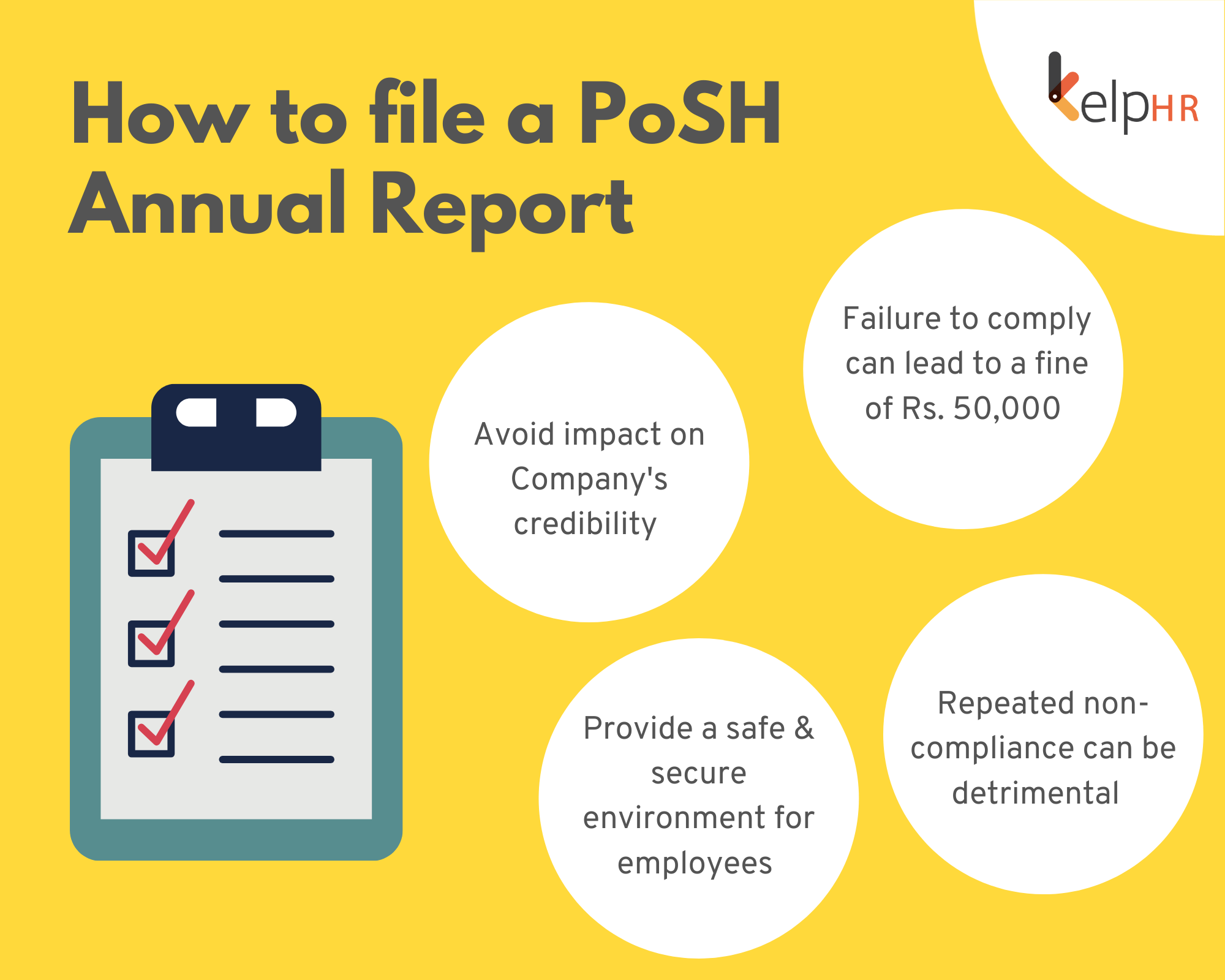
“If you think compliance is expensive, try non-compliance”
The Sexual Harassment of Women at Workplace (Prevention, Prohibition and Redressal) Act of 2013 (“Act”) provides protection to women against sexual harassment at workplace. It enlists certain compliances that needs to be ensured by every organisation with ten or more employees.
This leads the mind to most natural occurring way of thinking, the “Why?”- Why should one invest time and resources into it and why is it so important. The easiest response to this would be to say its mandatory!
The Law states that every employer shall be compliant with the compliances listed in the Act or be charged with penalty of INR. 50,000/- and in case of repeated non-compliance be charged with severe penalty and/or risk suspension/ cancellation of the license or registration to work.
What is Defined as Non-compliance?
The following acts of non-compliance can make the employer liable for a penalty of up to INR 50,000:
- Failure to constitute Internal Complaints Committee
- Failure to act upon recommendations of the Complaints Committee; or
- Failure to file an annual report to the District Officer where required; or
- Contravening or attempting to contravene or abetting contravention of the Act or Rules.
But there is another angle to the question “why” and that is visible only when you squint on it. The insidious answer to this is that sexual harassment attacks the work culture from within and affects the productivity and profitability of an organisation from behind the veil.
Why Compliance to the PoSH act or Sexual Harassment of Women at Workplaces (PPR) Act is Important
When sexual harassment occurs at a workplace, what happens next is barely documented. If left unaddressed, sexual harassment causes the workplace to be hostile for the aggrieved and more often than not affects the productivity and loyalty that the aggrieved employee has towards their organisation and in some cases it even leads to the exit of the aggrieved from the organisation. This exit, distrust has a cost. The loss of opportunity has an uncalculated loss for the organisation in terms of the loss of ideas, innovations, the effort and dedication that the aggrieved could have invested in their work.
It is this loss that being compliant can help us with. The Sexual Harassment of Women at Workplace Act 2013, provides for a very comprehensive mechanism that helps the employer assure a safe and conducive workplace to all its employees.
Companies are required to adopt a whole set of mechanisms which includes , anti-sexual harassment policy, employee sensitization sessions, constituting and training of internal complaints committee (ICC) members, etc. for drafting a zero-tolerance policy towards sexual harassment. To strengthen compliance, the act mandates filing of an annual report by the organisations.
One of such compliances and the most important one is the submission of Annual report. Annual Report is an effective monitoring tool for the Employers as well as the Government. It is an important yardstick against which one can measure the effectiveness and implementation of the compliances required by the Law.
What Needs to be Done.
The Internal Committee at the end of every calendar year needs to prepare an Annual Report which needs to be submitted to the Employer. The Employer in turn submits this Annual Report to the District Officer.
What Should the Annual Report Contain?
Rule 14 of the Act states that the following details need to be included in the Annual Report for the calendar year starting Jan 1 – Dec 31 of every year. Complaints refers to number of sexual harassment complaints in this case.
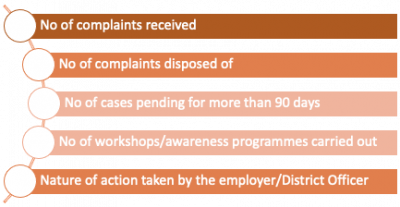
The District officer may issue notifications asking for more information that what is mentioned in the Act. It includes information on training sessions held for employee awareness and IC skill sessions. Other information pertaining to the mandatory compliances in the Act such as posters and notifications may also be required.
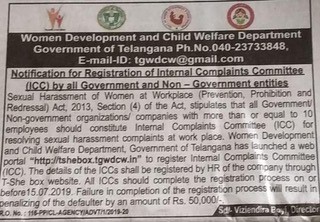
In some instances, registration of IC is also sought in addition to the submission of the Annual report. Notification for Karnataka (local language), Karnataka, Telangana, Pune
The District Officer for Mumbai released a template for the Annual Reports to be submitted.
Who is the Annual Report submitted to?
The Appropriate Government declares the District officer for each district. It may be the District Magistrate, Additional District Magistrate or Deputy Collector. Every district would have its own District Officer.
When to File the Annual Report?
The law is silent on the specific period of submission of Annual Report. But since the Law mentions that it needs to be submitted each calendar year, in case there is no notification to the contrary, it is recommended to submit the Annual report by 31st January every year.
The timeline may be extended by the District Officer.
Besides the questions answered in the Blog, there may be other queries like:
- If there is a template for the annual report?
- Where to obtain information on District officers?
- Confidentiality terms while filing the report?
To know more, Click here and fill the form to download a copy of the Annual report template and the district officer list and download here the annual report document for submission.
For information on how to fill the annual report and for trainings on POSH redressal mechanisms as well as trainings on Prevention of Sexual harassment in the workplace do write to us at info@kelphr.com or call us at +91-9500129652 and we would be glad to help you and your organisation comply with the law.
About the Author
Niharika Arora is a Subject Matter Expert in PoSH and an LL.M Graduate in International law, with knowledge and experience in Humanitarian, Human Rights and Corporate law. She is part of the Centre of Excellence (CoE) at KelpHR and a National certified Trainer. She is also an external member in several internal committees and has assisted and audited many more. She has a passion towards inclusion and equity.