Inclusive workplaces boost productivity by 30% Learn How
Partner With Us
Flag IN
IN
USA
UK

Addressing Gender Stereotypes in Job Roles

Addressing gender stereotypes at work

Table of Contents

Author

Kelp

When my super boss called me to his cabin, I assumed he wanted to guide me on preparing for the overseas Internal Job Posting that I had applied for. As a top performer, I knew I had a good chance of being selected.

Sadly, he hadn’t called to provide me guidance. The meeting circled around whether I had discussed the application with my husband and both our families, and what their reactions were. I was asked to rethink if plans to start my own family, if any, were in sync with the decision to apply for an overseas position.

Discouraged, I naively remember asking a male colleague who had applied as well, if he had received such a meeting invite? He hadn’t.

Did I feel disappointed at the turn of events? Yes.

But did I realize then, that my super boss had gender-stereotyped me? No.

What are Gender Stereotypes?

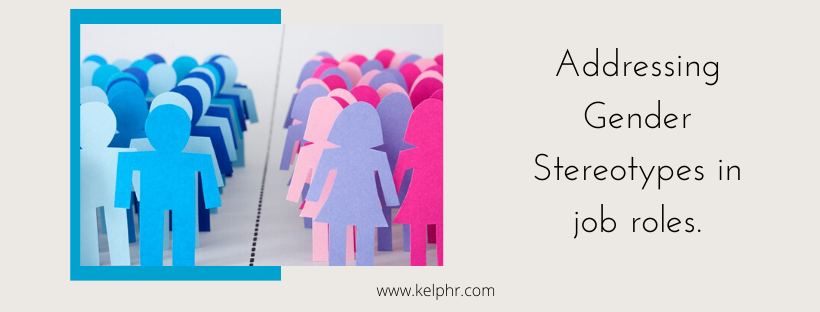
Gender stereotypes are preconceived ideas that attribute specific characteristics to all the members of the gender. For instance, men are leaders and that they are good at science.1 Or that women are great at being caretakers and are natural collaborators.

The impact of gender stereotypes

  • World over, men are held in higher esteem and considered to be more powerful and promising when compared to women. As a result, when men and women receive identical performance appraisal ratings, studies have shown that male employees are more likely to be promoted.
  • A negative correlation between women and power and success2 results in women facing the brunt of gender stereotyping in resume selection, interviews, hiring, salary, performance appraisals, potential, opportunities, and promotions.
  • Men also experience gender stereotyping by being disincentivized for opting for roles traditionally held by women, etc.
  • When gender stereotyping overlaps with stereotyping against races or people of color or those in minorities, its impact is amplified.

Gender stereotypes exist everywhere and in everyone

They are deep-rooted and incredibly tough to uproot. Organizations that invest in Diversity training programs to educate employees witness limited impact because employees emerge from the training equipped to identify the biases and stereotypes in others, but not their own!

Behavioral Economist, Iris Bohnet, shows us another approach to remove gender stereotypes – By Debiasing and redesigning organization processes.

How do we remove Gender Stereotypes at work?

Recruitment:

  • Use Neutral language in JD’s: Gendered languages in JD’s are biased towards men. For instance, the use of ‘ninja’ in JD’s increased by 400% in recent years3. Associated with masculinity, it did not resonate with female applicants who didn’t always apply for such jobs. Using neutral language not only eliminates gender bias but also helps organizations receive a larger number of applicants4.
  • Hide Demographics: Candidates have a better shot at an unbiased interview when organizations hide their ‘name, gender, address and educational background’ from the resume.
  • Ask for work samples: By asking for work samples and weighing it high in evaluation, interviewers are less likely to succumb to gender stereotypes.
  • Structured Interviews and Fixed Evaluation Criteria: Structured interview formats with fixed evaluation criteria help interviewers stay objective.
  • Comparative Performance evaluations: Evaluating an employee’s performance as well as relative performance to the peer group, ensures merit in the process.

Breaking down existing stereotypes:

  • Training: Training helps employees understand biases and gender stereotypes, but provides modest gains. However, they are ineffective when made mandatory.
  • Model behavior: When senior employees model the behavior they want to spread, it becomes the new norm, that employees try to match. For instance, calling out those who engage in gendered behavior.
  • Symbols of gender-equality: Actions like gender pay-gap audits, transparency in promotion criteria, equal access to mentors, default gender-neutral benefits (Telstra offers flexibility for all employees) enables equality.
  • There is a heightened sense of awareness of gender stereotypes across organizations around the world. It behooves organizations to redesign their processes and tackle gender-stereotypes, to benefit from a gender-balanced workforce.
  1. https://www.nature.com/articles/495033a
  2. https://www.businessnewsdaily.com/9434-gender-neutral-job-ad.html

Recent Posts

Categories

Calendar Icon Events
Close

Event Calendar

MAY 2026

MO
TU
WE
TH
FR
SA
SU
27
28
29
30
1
2
3
4
5
6
7
8
9
10
11
12
13
14
15
16
17
18
19
20
21
22
23
24
25
26
27
28
29
30
31

Head – Client Relations

Gomathi Venkatasubramanian is a seasoned client relations and strategy leader with over nine years of experience in sales, client engagement, and conflict resolution. As the Head of Client Relations, Gomathi and her team ensure that every Kelp client enjoys excellence in service delivery and engagement.  With her vast product knowledge, Gomathi takes pride in being able to go beyond the call to action and provide innovative solutions and services to clients that align with their people and business goals.

Prior to Kelp, Gomathi worked with organizations across the sales and presales cycles thereby acquiring a deep understanding of the process and how to shift from a sales to a solutions mindset.  That has helped her in honing her unique style in building client relations and trust.

Beyond her professional pursuits, Gomathi enjoys traveling and exploring new destinations, embracing different cultures and perspectives. She also finds solace in Indian music, which serves as a source of relaxation and inspiration.


Navneet Chugh

Director & Entrepreneur

Navneet, Managing Partner of Chugh LLP, offers global legal and tax services with 575 employees. An Attorney, CPA, and MBA from USC, he founded SABA and TiE Southern California and serves on multiple boards globally.

Bhaskaran MR

Director & Entrepreneur

Baskaran Rajaraman is an entrepreneur with interests in real estate, healthcare, and eCommerce. He has previously consulted with Krossark, Citrisys, Booz Allen, and Hamilton, and Polaris on BFSI, eCommerce, and logistics.

Manju Manocha

Head - Business Development

Manju, Head of Business Development at Kelp, drives sales strategy and growth. An HR expert with a master’s in Personnel Management, she has worked with Mphasis, BMC, Syntel, and WNS.

Smita Mukharjee

Head – DEI Center of Excellence

Smita is a dynamic and experienced DEI and Learning Consultant with a unique blend of academic expertise and practical application. With an MBA from the University of Mumbai and an M.Phil from the esteemed Tata Institute of Social Sciences, she is currently pursuing a PhD.

Smita brings with her over a decade and a half of experience across both academia and corporate training and has helped shape the learning journeys of professionals across industries. Her expertise spans human behaviour, training and development, research, and organizational diagnostics. Smita’s research has been showcased at prestigious institutions, including IIM Indore, IIM Bangalore, IIM Trichy, and Nirma University..

Passionate about fostering diversity and inclusion, Smita brings an engaging approach to training, blending research-driven insights with interactive methodologies. Beyond her professional commitments, she enjoys exploring new cultures and perspectives through travel, always seeking to broaden her understanding of the world.

Shalu Salwan

Chief Operating Officer

Shalu, an MBA from ISB, leads operations and product development at Kelp, focusing on efficiency and impact. Passionate about L&D, DEI, and PoSH, she thrives on adventure—whether scaling mountains or exploring the ocean.

Elango R

Global Leader

Elango, Global CHRO and Business Head at MphasiS, grew the company from $12 million to over a billion. He led key integrations, integrated CSR practices, and has held leadership roles at Raheja Group, UB Group, and Bank of America.

Rangan Mohan

Veteran Executive Coach

Rangan Mohan, an executive coach with 30 years of experience, has held CEO roles at MphasiS and Hinduja Global Solutions. A graduate of Madras University and IIM Ahmedabad, he is now a director and consultant.

Deepa Padmanaban

Head – Learning Solutions and PoSH Center of Excellence

Deepa, an MBA and Certified PoSH trainer, excels in client experience and HR. At Kelp, she fosters inclusivity through collaboration. Passionate about singing and voice artistry, she also announces for All India Radio.