IN

 USA
 CA
 IN
It is October.
Your annual appraisal cycles are live, Q4 targets are being revised, and somewhere in the middle of all of it sits a compliance task that almost every HR team delays until January: the PoSH Annual Report.
Every year, the pattern is the same. The IC scrambles to reconstruct twelve months of data it should have been tracking all along. The Presiding Officer is unsure what she needs to sign. Someone discovers the SHe-Box registration was never completed. Regional-language posters are missing from two office locations and the report gets filed late, or incomplete, or both.
The good news: you have three months. October, November, and December are exactly the window you need if you use them deliberately.
We break down what the PoSH Annual Report actually requires, the mistakes that happen every year without fail, and a structured 3-month plan to make sure January is calm rather than chaotic.
What the PoSH Annual Report Is and Why It Is Not Optional
Under the Sexual Harassment of Women at Workplace (Prevention, Prohibition and Redressal) Act, 2013, Rule 14 of the PoSH Rules requires every Internal Committee to prepare an Annual Report at the close of the calendar year and submit it to the employer. The employer then files it with the District Officer.
The law sets no fixed date, but 31 January is the established filing deadline, covering the period 1 January to 31 December of the prior year.
Non-filing is not a minor oversight. The penalty under the PoSH Act is a fine of up to Rs 50,000 for a first offence. Repeat violations attract doubled penalties, and in serious cases, the organization risks suspension or cancellation of its operating licence. For listed entities, PoSH non-compliance also creates regulatory disclosure and reputational exposure.
The Annual Report must contain:
- Number of complaints received during the calendar year
- Nature of those complaints (categories of conduct alleged)
- Number of cases disposed of and their outcomes
- Number of cases pending as of 31 December and reasons for pendency
- Number of awareness sessions conducted for employees
- Number of IC training or skill-building sessions held
The Presiding Officer signs on behalf of the full IC. The employer, not the External Member, is responsible for filing with the District Officer.
One Thing SMEs Get Wrong From the Start
Before we get to the execution mistakes, there is a foundational one that trips up smaller organizations every year.
PoSH compliance is based on headcount, not company size.
If your organization has 10 or more employees, you are legally required to constitute an Internal Committee and comply with all PoSH obligations including the Annual Report. Being a startup, an early-stage company, or a lean team does not exempt you.
Five compliance essentials that every organization, regardless of size, must have in place:
An External Member on the IC. Regular employee awareness training. A documented complaint process. The Annual Report filed. And SHe-Box registration completed.
Each of these is a legal requirement, not a best practice suggestion.
The Mistakes That Happen Every Year
1. The IC Has Not Been Meeting and Has No Records to Show
The Annual Report is not a year-end task. It is the output of a year-round process. If your IC has not held documented quarterly meetings, maintained a running case log, and tracked its activities in real time, there is nothing to compile in January.
This is the single most common failure. Organizations treat the IC as a body that activates when a complaint arrives. In reality, the IC has ongoing obligations: regular meetings, awareness activities, IC member training, and record-keeping. The Annual Report is simply the annual summary of that work.
If your IC is currently inactive or has not met since it was last constituted, October is the moment to restart — not because January is coming, but because the IC’s obligations do not pause.
2. Regional-Language Posters Are Missing or Outdated
The PoSH Act requires employers to display information about the IC in a prominent place at the workplace. In multilingual workplaces and across India, most are this means posters in the regional language relevant to that location.
This is one of the most consistently missed compliance items. Organizations display English-language IC information at their registered office and consider the obligation met. Meanwhile, manufacturing units, warehouses, field offices, and regional branches go without.
If your organization operates across more than one location, auditing your poster display should be a specific October action. Check: Is the IC information visible? Is it in the relevant regional language? Does it include the IC members’ names, contact details, and mention sexual harassment as a punishable offence?
A missing poster is a compliance gap. It is also the difference between an employee knowing where to go for help and not knowing.
3. SHe-Box Registration Has Not Been Done
The SHe-Box (Sexual Harassment electronic Box) is the government’s centralised online portal for employees to register PoSH complaints and for employers to register their ICs.
A significant number of organizations are either unregistered on SHe-Box or have outdated IC details on file. This is increasingly a focus area for compliance audits.
IC registration on SHe-Box includes the IC members’ names, tenure, the organization’s address,including details of branch offices. If your IC has had any changes in membership a new External Member, a new Presiding Officer, departures those need to be updated.
Check your SHe-Box status in October. If you are not registered, register immediately. If your details are stale, update them. This is a one-time effort with ongoing compliance value.
4. Zero Complaints Does Not Mean Zero Risk
An Annual Report showing zero complaints year after year gets filed with quiet relief. But it should prompt a question, not relief.
Does zero complaints mean your workplace has genuinely zero incidents of harassment? Or does it mean employees do not know the IC exists, do not trust the process, or are afraid to come forward?
These are fundamentally different situations. Filing a zero-complaint report without examining which applies is a governance risk hiding in plain sight.
The Annual Report period should trigger an awareness audit alongside the data audit. How many employees attended PoSH training this year? What percentage of new joiners were inducted? Is the IC contact information accessible to remote and hybrid employees? Has the IC been visible and approachable, or purely administrative?
If awareness is low, the training calendar for November and December still has time to address it before the report is filed.
5. Training Records Cannot Be Verified
The Annual Report requires the number of awareness sessions conducted. Every year, organizations either cannot verify this number because no one tracked it, or discover that the sessions were run but no records were maintained.
An unverifiable number is a governance failure. An inflated number is a compliance misrepresentation.
Awareness sessions need a log: date, facilitator, audience, format, approximate participant count. This log belongs with the IC, not just with whoever organised the training. If you have been using a third-party training provider, ensure you have documentation of every session delivered, not just an invoice.
If your training records for 2026 have gaps, the next two months are the window to fill them with real sessions, documented properly.
6. IC Member Training Has Not Happened
The Act requires IC members to be trained. This is not an optional professional development. It is a legal obligation and it is one of the items the Annual Report must reflect.
IC members who have not been trained cannot conduct inquiries competently. They may misapply natural justice principles, breach confidentiality obligations, or handle cross-examination incorrectly. The consequences of a flawed inquiry process can be severe — for the complainant, the respondent, and the organization.
If your IC members have not undergone formal training this year, that needs to be addressed before December ends. A session in November or December can still be reflected in the 2026 Annual Report.
7. The Presiding Officer Does Not Own the Report
In many organizations, the Annual Report lands with HR by default because HR manages administrative processes. But the Annual Report is an IC document. The Presiding Officer, the senior woman employee who chairs the IC, is responsible for its accuracy and submission to the employer.
When HR completes the report without the Presiding Officer’s active involvement, you get a document that may be administratively tidy but legally uncertain. If the Presiding Officer has been disengaged from the IC’s work through the year, she will not have the knowledge to review it accurately.
The Presiding Officer must be an active participant in the Annual Report review and must sign it. If she is unclear on this role, that clarity needs to happen now.
A 3-Month Plan: October, November, December
The creatives your HR team has been seeing from Kelp this quarter map to a deliberate three-month structure. Here is how to use each month.
October: Review
This is the audit month. Pull everything and assess where you stand.
Review your PoSH policy. Is it current, does it reflect any operational changes, has it been updated for remote and hybrid work applicability?
Check regional-language posters at every location your organization operates. Confirm they are displayed, updated, and includes current IC contact details.
Verify IC constitution and records. Is the IC fully constituted, are there vacancies, is the External Member’s term valid, are case records complete?
Check SHe-Box registration status and update if needed.
November: Close the Gaps
With the audit done, November is for action on every gap identified.
Run pending awareness sessions and document them. Complete IC member training. Address any IC vacancies. Update the complaint process if the review revealed ambiguity. Organize your case, training, and SHe-Box records into a format the Annual Report can draw from directly.
December: Be Ready
December is finalisation. The IC should meet, review the full year’s activity, and begin preparing the Annual Report draft.
By the time January arrives, the report should be a matter of reviewing and signing a document that reflects work already done — not a scramble to remember what happened in March.
What a Complete Annual Report Says About Your Organization
Beyond the legal requirement, the Annual Report is a signal.
An organization that files a complete, accurate Annual Report — one that reflects active IC meetings, documented training, fair case handling, and trained IC members — is one that takes the safety commitment seriously. This matters in employer brand assessments, SEBI compliance reviews for listed entities, and increasingly in how talent evaluates organizations when making career decisions.
The Annual Report is not paperwork. It is a record of whether your workplace safety framework is real or administrative theatre.
How Kelp Can Help Before the Deadline
If your IC needs a structured review, training, or support preparing the Annual Report, the window is now.
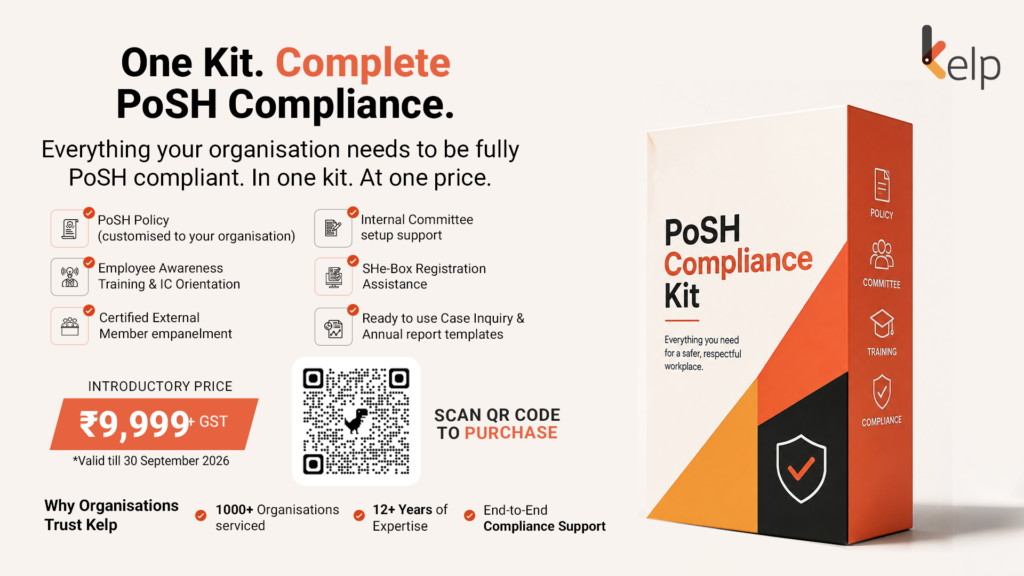
Kelp’s PoSH Annual Report Filing Service is built specifically for this period supporting organizations in getting compliant before January.
For IC member training before the year closes, Kelp’s PoSH Training programmes cover both employee awareness and IC-specific certification.
For organizations that want end-to-end support, policy review, IC health check, training, filing guidance Kelp’s PoSH Advisory covers the full scope.
Reach out to Kelp today. The report is due in January. The work to get there starts in October.