IN
IN

 USA
USA
 CA
CA
 IN
IN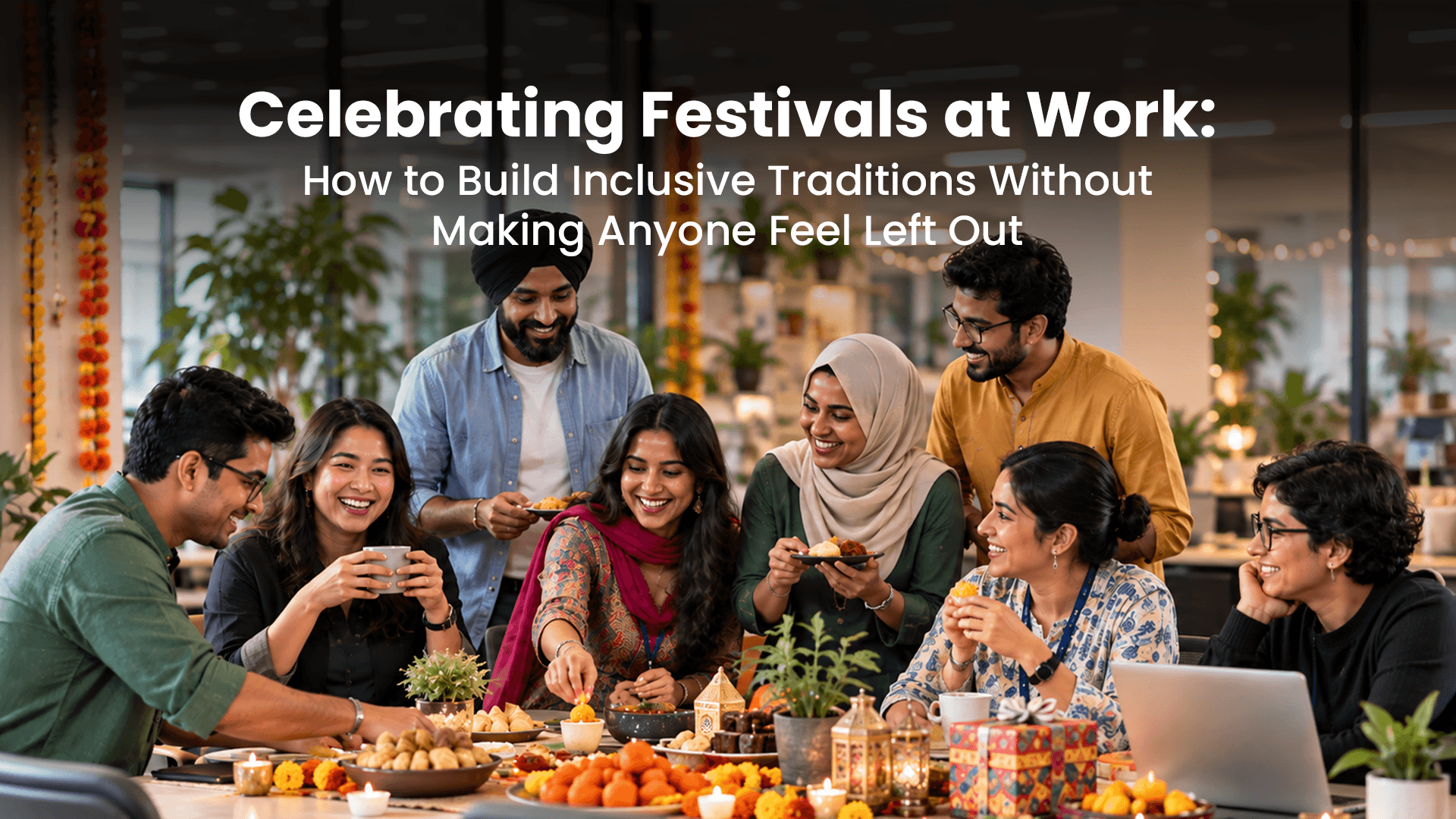
October arrives, and something changes in the workplace.
The pantry starts filling up with sweets. A Navratri playlist makes its way onto the office speakers. Someone puts up the first set of Diwali lights. A Christmas tree appears in December.
Teams start planning their year-end celebrations.
For many employees, these moments bring energy, connection and a sense of togetherness.
But for HR, there is another question worth asking:
Do our workplace celebrations make everyone feel included, or do they unintentionally make some people feel like outsiders?
This is not about taking the joy out of festivals. Quite the opposite.
Festival celebrations are one of the most visible expressions of that culture. When handled thoughtfully, they can communicate something simple and powerful:
There is space here for different identities, traditions and choices.
When handled without much thought, even a well-intentioned celebration can leave some employees feeling overlooked or pressured to participate.
India’s workforce reflects an enormous range of cultural and religious traditions. During the October to January period alone, organizations may have employees observing:
- Navratri and Garba: 11–19 October 2026
- Dussehra / Vijayadashami: 20 October 2026
- Diwali: 8 November 2026
- Guru Nanak Jayanti: 24 November 2026
- Christmas: 25 December 2026
- New Year: 1 January 2027
And that is only part of the picture.
There are regional festivals such as Durga Puja, Pongal, Bihu and Onam, along with Buddhist and Jain observances, Eid and many others. There are also employees who do not observe religious festivals at all.
For HR teams, the question is therefore not, “How many festivals should we celebrate?”
It is:
“How do we create a workplace where people can participate in celebrations without feeling that they have to fit into one particular cultural norm?”
Where Workplaces Can Get This Wrong
Most workplace festival practices are not intended to exclude anyone. They usually develop organically – one team starts a celebration, another copies it, and over time it becomes part of “how we do things.” But small habits can sometimes create unintended pressure.
- Celebrating only the festivals that are most visible
The office may be beautifully decorated for Diwali, have a Christmas tree and organise a Navratri event, while other festivals pass with little or no acknowledgement. There is nothing wrong with celebrating these festivals. The issue arises when employees repeatedly see some traditions represented while theirs are rarely, if ever, acknowledged.
- Making “optional” events feel compulsory
An event may technically be voluntary, but if a manager notices who attended, if the event is scheduled during working hours, or if participation is repeatedly described as “team bonding”, employees may not experience it as optional. For someone who does not celebrate that festival, declining can start to feel like a workplace decision rather than a personal one.
- Assuming everyone celebrates the same way
Questions such as “What are you doing for Diwali?”, “Are you fasting for Navratri?” or “Are you doing puja at home?” are often meant warmly. But not everyone observes the same traditions.
A more inclusive approach is to remain curious without making assumptions about what an employee believes, celebrates or practises.
- Creating an unspoken hierarchy of festivals
Some occasions may receive all-hands communication, decorations, gifts and special events, while others get a brief mention in a newsletter. Employees notice these differences.
Again, the answer is not necessarily to celebrate every festival in exactly the same way. That would neither be practical nor meaningful. The important thing is to think consciously about visibility, acknowledgement and representation.
What Inclusive Festival Celebration Actually Looks Like
Being inclusive does not mean removing cultural identity from workplace celebrations.
A Diwali celebration should still feel like Diwali. A Navratri event can have music, colour and Garba. Christmas can be celebrated with warmth and enthusiasm. The objective is not to make every celebration identical.
It is to make sure that participation is a choice, cultural differences are respected, and no employee feels that their identity – or their decision not to observe is a problem.
For HR teams, that can translate into a few simple practices.
- Acknowledge the wider calendar
Not every festival needs an office party.
Sometimes a message from leadership, a note on the intranet or a mention in the internal newsletter is enough to let employees know that the occasion is recognized. The point is not to create more events. It is to avoid making inclusion dependent on which festivals happen to be most familiar to the majority.
- Make participation genuinely optional
If an event is voluntary, let it be voluntary. Avoid scheduling celebrations during mandatory meetings. Avoid language that suggests attending is part of being a good team player.
Employees should be able to say, “I don’t celebrate this,” or simply choose not to attend, without having to explain themselves.
- Ask employees rather than assuming
A short employee survey before the festive season can be surprisingly useful. Ask what employees would enjoy, which occasions matter to them, and whether there are any considerations HR should keep in mind. It takes very little time and can prevent well-intentioned plans from becoming unintentionally exclusive.
- Think about flexibility in leave
The standard holiday calendar cannot reflect every cultural or religious observance that matters to employees.
Where possible, flexible or floating holidays can give employees greater choice over which days they take off. This can be particularly meaningful in a diverse workforce because inclusion is not only about what the organization celebrates collectively. It is also about giving people some choice over the occasions that matter personally to them.
- Don’t overlook food
Food is often at the centre of workplace celebrations – and it can also be where inclusion becomes very practical. Vegetarian, Jain, halal and other dietary requirements should be considered when planning shared meals. Employees should not have to repeatedly explain or defend their dietary choices simply to find something they can eat at a workplace event.
- Equip managers
This is perhaps the most important part. HR can design an inclusive celebration, but the day-to-day experience is often shaped by the manager.
A manager who asks why someone did not attend the Diwali party, assumes everyone is available for a Christmas celebration, or treats participation in Garba as a team-bonding expectation can unintentionally undo the effort HR has put into creating an inclusive environment. Managers need simple guidance on how to recognize and respect differences without making them awkward.
A Simple Guide For HR & People Managers
A practical summary for HR teams and people managers heading into the festival season:
| Do This | Instead of This |
| Ask employees what matters to them | Assume everyone celebrates the same festivals |
| Make participation genuinely voluntary | Make celebrations feel mandatory or link them to team spirit |
| Acknowledge a wider range of festivals | Give prominent visibility only to a few occasions |
| Offer flexibility where possible | Assume the standard holiday calendar works equally for everyone |
| Consider dietary requirements when planning food | Expect employees to explain why they cannot eat something |
| Help managers understand cultural differences | Leave festival culture entirely to the “fun committee” |
| Respect employees who choose not to participate | Treat absence as a lack of enthusiasm or engagement |
And What About Employees Who Don’t Celebrate?
This is an important part of the conversation.
Not every employee celebrates religious festivals. Some may be atheist or agnostic. Others may simply not observe religious traditions. And some employees may celebrate privately but prefer not to participate in workplace activities. None of these choices need to be explained or justified. An inclusive workplace makes room for participation and non-participation.
That can be as simple as not asking, “Why aren’t you joining?” or suggesting that someone is missing out on team spirit because they chose not to attend.
The message should be straightforward:
You are welcome to participate. You are also welcome to choose not to!
How Kelp Can Help
Building an inclusive workplace culture is not something that can be achieved through one annual training programme or a festival calendar. It involves the way policies are designed, managers are equipped, employees are sensitized and everyday workplace practices are shaped.
Kelp works with organizations across India and in 53 countries to help make DEI more structured and sustainable.
Our work includes:
DEI Training for Employees and Managers
Building awareness around cultural and religious diversity, unconscious bias and inclusive workplace behaviours.
Unconscious Bias Training
Helping managers recognise assumptions they may make about what employees celebrate, how they participate and what their choices mean.
Inclusive Leadership Training
Giving people managers practical tools to create team environments where different identities and perspectives are respected.
DEI Strategy and Advisory
Helping organizations move beyond individual initiatives and build inclusion into the broader employee experience and organizational culture.
DEI Audit
Helping organizations understand where they currently stand on inclusion and identify areas where their practices may unintentionally leave people out.
If your organization is looking to build a more inclusive workplace culture, Kelp can help with DEI training, inclusive leadership workshops and DEI audits.