IN
IN

 USA
USA
 CA
CA
 IN
IN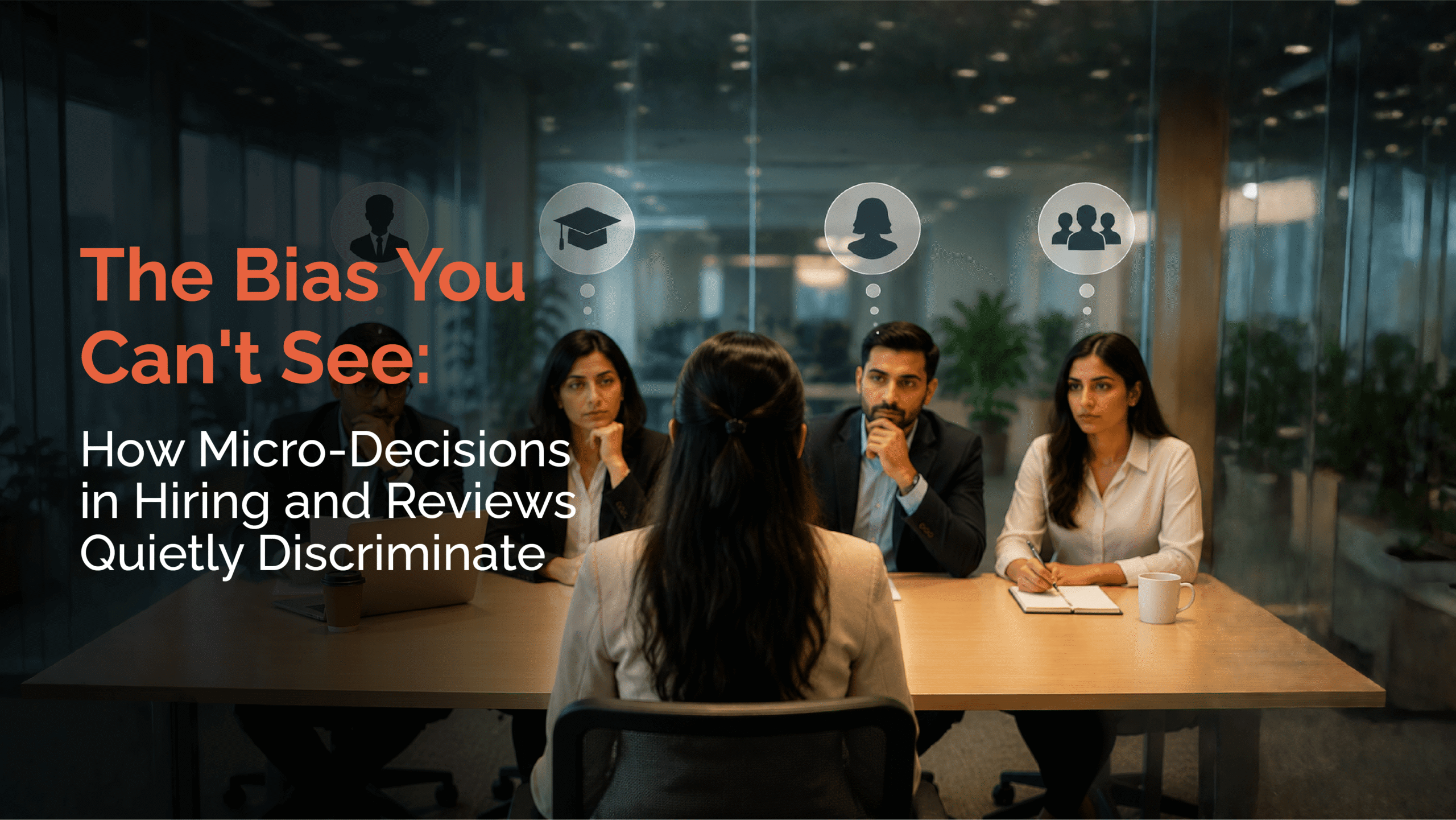
Two resumes land on a recruiter’s desk. Same qualifications, same college, same city. One belongs to Priyanka Sharma, the other to Habiba Ali. Over the next eight months and 1,000 applications, Priyanka receives roughly double the callbacks. Habiba rarely gets a follow-up phone call.
This is not a thought experiment. It is a correspondence study conducted by the LedBy Foundation in India, and its findings carry a net discrimination rate of 47.1%. The resumes were identical. The only variable was the name at the top of the page.
Bias of this kind does not look like prejudice in the moment. Nobody in those companies likely believed they were discriminating. The recruiter glancing at a name, the hiring manager favouring a candidate who “feels like a fit,” the reviewer reaching for the word “abrasive” to describe a woman displaying the same assertiveness that earns a man the label “decisive”: these are micro-decisions. They happen in seconds, without conscious intent, and they compound over time into patterns that shape who gets hired, who gets promoted, and who quietly leaves.
This month, Kelp’s content theme is “Bias Lives in the Details.” It is a theme grounded in a specific premise: the most consequential forms of workplace discrimination are not overt acts of hostility. They are the small, patterned choices embedded in processes that organisations trust to be fair.
The Business Cost of Bias: According to McKinsey’s Diversity Matters Even More (2023), companies in the top quartile for gender diversity on executive teams are 39% more likely to achieve above-average profitability. Conversely, Deloitte (2020) found that companies lacking inclusive practices face up to 40% more employee turnover. In India specifically, a 2023 World Bank estimate found that closing the gender gap in the workforce could boost India’s GDP by $770 billion. Bias is not just an ethics issue. It is a business performance issue.
It Starts at the Resume Screen
Name-based discrimination at the resume screening stage is the most extensively documented form of hiring bias globally, and India is no exception. The Thorat and Attewell correspondence study found that applicants with Dalit or Muslim names received significantly fewer callbacks from private sector companies compared to identically qualified candidates with upper-caste Hindu names. A follow-up analysis found that low-caste applicants needed to send 20% more resumes than high-caste applicants to receive the same number of callbacks, with the gap widening when recruiters were male.
International research mirrors this. Studies across the US, UK, and Europe consistently find that candidates with names signalling minority ethnic or racial backgrounds receive 30 to 50% fewer callbacks for identical qualifications. A 2000 study by Goldin and Rouse famously documented the flip side: when orchestras introduced blind auditions behind a screen, the probability of women advancing increased by 25 to 46%.
A 2024 study on gender bias in Indian hiring found that 42% of female candidates were asked at least one personal question during interviews (about marital status, children, or family background), compared to 33% of male candidates. A disparity that reveals how identity assessment begins well before the formal screening stage. (Source: Feminism in India / Survey-based research, 2024)
The pattern is remarkably consistent. When the process allows the evaluator to infer identity before assessing competence, the evaluation shifts. Not dramatically, not maliciously, but enough to produce measurable gaps in outcome.
The Interview Room: Where “Culture Fit” Does Its Quiet Work
If resume screening is the first filter, the unstructured interview is the second. Research shows that structured interviews, those with predetermined questions, behavioural anchors, and consistent scoring rubrics, improve predictive validity by roughly 50 to 100% compared to unstructured formats. Structured formats also significantly reduce the influence of cognitive biases like the halo effect, similarity bias, and confirmation bias.
Yet most organisations in India still rely heavily on unstructured conversations, where hiring managers assess whether a candidate “feels right” for the team. That instinct is not neutral. Affinity bias, the tendency to favour people who resemble us in background, communication style, or education, operates most powerfully in informal settings. The hiring manager does not think “I’m choosing someone who looks like me.” They think “this person gets it” or “they’ll fit right in.”
A 2024 Glassdoor survey found that 76% of job seekers consider workplace diversity an important factor when evaluating job offers. Yet despite this stated preference, most hiring processes remain structurally vulnerable to affinity bias because diversity is assessed at the outcome level while bias operates at the process level.
The cost of that instinct is not just individual unfairness. It is a progressive narrowing of the talent pool, where teams become more homogeneous over time and the people who were never called back never appear in any internal diversity metric because they were filtered out before they entered the system.
The Performance Review: Where Bias Gets Institutionalized
Hiring is one decision point. Performance reviews are hundreds of them, repeated annually, and they have an outsized influence on promotions, pay raises, and career trajectories. This is where bias stops being episodic and becomes structural.
A Harvard Business Review analysis of performance evaluations at a Fortune 500 technology company found that women were 1.4 times more likely than men to receive critical subjective feedback, the kind tied to personality rather than measurable performance. Stanford research led by Shelley Correll documented a parallel finding: men receiving critical feedback tended to get developmental, action-oriented guidance (“lead the next project,” “improve stakeholder engagement”), while women received vaguer assessments tied to personality traits rather than work output.
A 2022 Textio study on workplace language found that women were 11 times more likely than men to be described as “abrasive” in performance reviews. A pattern that held across similar roles and seniority levels and extended to distinct feedback of disparities across race and ethnicity as well.
The downstream consequences are significant. According to McKinsey (2023), women hold only 17% of executive positions in India despite representing a growing share of entry-level hires, a gap that cannot be explained by pipeline alone. Deloitte’s Women at Work Report (2024) found that 41% of women reported requesting reduced work hours due to workplace pressures, and 31% reported mental health challenges. Biased performance reviews that stall careers contribute directly to both figures.
The language gap may seem small in any single review. But performance reviews are cumulative documents. They build a paper trail that follows an employee across years, feeding into promotion decisions, compensation benchmarks, and leadership pipelines. Vague feedback today becomes a stalled career two years from now, and the person who received it may never understand why.
The Indian Workplace Layer: Where Caste, Class, and Gender Intersect
Global bias research provides the framework. But in India, the dimensions are more layered. Caste, religion, regional background, language fluency, gender, and socio-economic class all intersect in ways that make bias harder to isolate and harder to name.
India currently lacks a comprehensive, codified non-discrimination statute that regulates private employers and compensates victims of workplace discrimination. (Source: Great Place to Work India, 2025.) This legislative gap means that bias in hiring and reviews is not only culturally entrenched; it is largely unpunished. In this context, process design is not nice-to-have. It is the only safeguard that exists.
Consider how “communication skills” functions as a screening criterion in many urban Indian organisations. It often means fluent, accent-neutral English, which is a proxy for a specific kind of schooling, which is a proxy for a specific class background. The criterion sounds objective. It is written into job descriptions and scoring rubrics. But it filters out capable candidates whose educational access looked different, not because they cannot do the job, but because they do not perform competence in the expected register.
Or consider the subtle dynamics of task allocation. In many Indian workplaces, high-visibility projects, the ones that lead to recognition and promotion, cluster around a familiar set of faces. The pattern is rarely deliberate. Managers assign work to people they trust, which usually means people they already know well, which usually means people who resemble them in background or working style. The rest get operational or administrative work that keeps the team running but never generates a promotion case.
A national survey cited in recent research found that 77% of Indian employers believe that not prioritising diversity, inclusion, and belonging could harm business performance, yet only 21% had formal policies in place. (Source: PTI / Lex Localis Journal, 2022.) The intent-practice gap is wide, and it is in that gap where bias does its quiet work.
This is what makes bias in micro-decisions so difficult to address awareness alone. Each individual decision looks reasonable. It is only when you zoom out and look at patterns across dozens of decisions, across hiring, task allocation, feedback, and promotion, that the cumulative effect becomes visible.
Why Awareness Training Alone Is Not Enough (and What Is)
There is an important finding in the research that any honest conversation about unconscious bias must acknowledge: meta-analyses of unconscious bias training consistently show near-zero impact on actual hiring or promotion behaviour when the training is not accompanied by process-level changes. A meta-analysis of 492 studies (Forscher et al., 2019, total N > 87,000) found that no study demonstrated reductions in implicit bias lasting more than 24 hours when training was delivered in isolation. Telling people that bias exists does not change how they make decisions under time pressure.
What does change outcomes is changing the process itself. The evidence points clearly in a few directions.
- Blind screening reduces name-based discrimination by 30 to 50%. Removing names, photographs, and institution names from the initial screening round forces evaluators to engage with qualifications before identity.
- Structured interviews with standardised questions and scoring rubrics constrain the influence of gut instinct and personal affinity. They make decisions auditable, which means they can be reviewed for patterns. Meta-analytic evidence (Campion, Palmer & Campion, 1997; replicated extensively since) shows structured interviews are among the single highest-validity predictors of job performance and also the most effective at reducing adverse impact on minority candidates.
- Defined evaluation criteria in performance reviews replace subjective language with observable, measurable standards. Instead of “she needs to develop her executive presence,” the review says “she led three cross-functional projects and delivered all three within budget.” One of those sentences is actionable. The other is feeling dressed up as feedback.
- Diverse hiring panels reduce the probability that a single evaluator’s affinity bias determines the outcome. They do not eliminate bias, but they introduce friction into what would otherwise be an unchallenged individual judgment.
- Regular audits of outcomes matter more than audits of intent. The question is not “do we believe we hire fairly?” It is “do the numbers show equitable callback rates, interview-to-offer conversions, and promotion rates across demographic groups?” Research consistently shows that employees who experience or witness bias and discrimination are 1.4 times more likely to leave their organisation. (Source: Engagedly DEI Research, 2024.) Outcome audits make that attrition risk visible before it becomes a retention crisis.
This is where Kelp’s Unconscious Bias Training is designed to sit: not as a standalone awareness session that checks a box, but as the starting point for a process-level intervention. The training names the patterns, builds shared vocabulary, and connects directly to the structural changes, interview design, rubric development, review calibration, that shift outcomes.
The Question Worth Sitting With
If you run a hiring process, a performance review cycle, or a promotion pipeline, the question is not whether bias exists in your system. The research is too consistent and too replicated for that to be a serious debate.
The question is whether your processes are designed to surface it or to hide it. Whether your review language is vague enough for bias to live comfortably inside it. Whether your interview formats give affinity bias room to operate unchecked. Whether the patterns in your callback data, your promotion data, and your attrition data would tell a story you are comfortable defending.
Bias lives in the details. The first step is building systems that make it visible.
Kelp’s Unconscious Bias Training helps teams move from awareness to action, with structured workshops that connect directly to hiring, review, and promotion processes. If your organisation is ready to audit the micro-decisions that shape outcomes, we should talk.
📩 info@kelphr.com | 📞 95001 29652 | 🌐 www.kelphr.com