IN

 USA
 CA
 IN
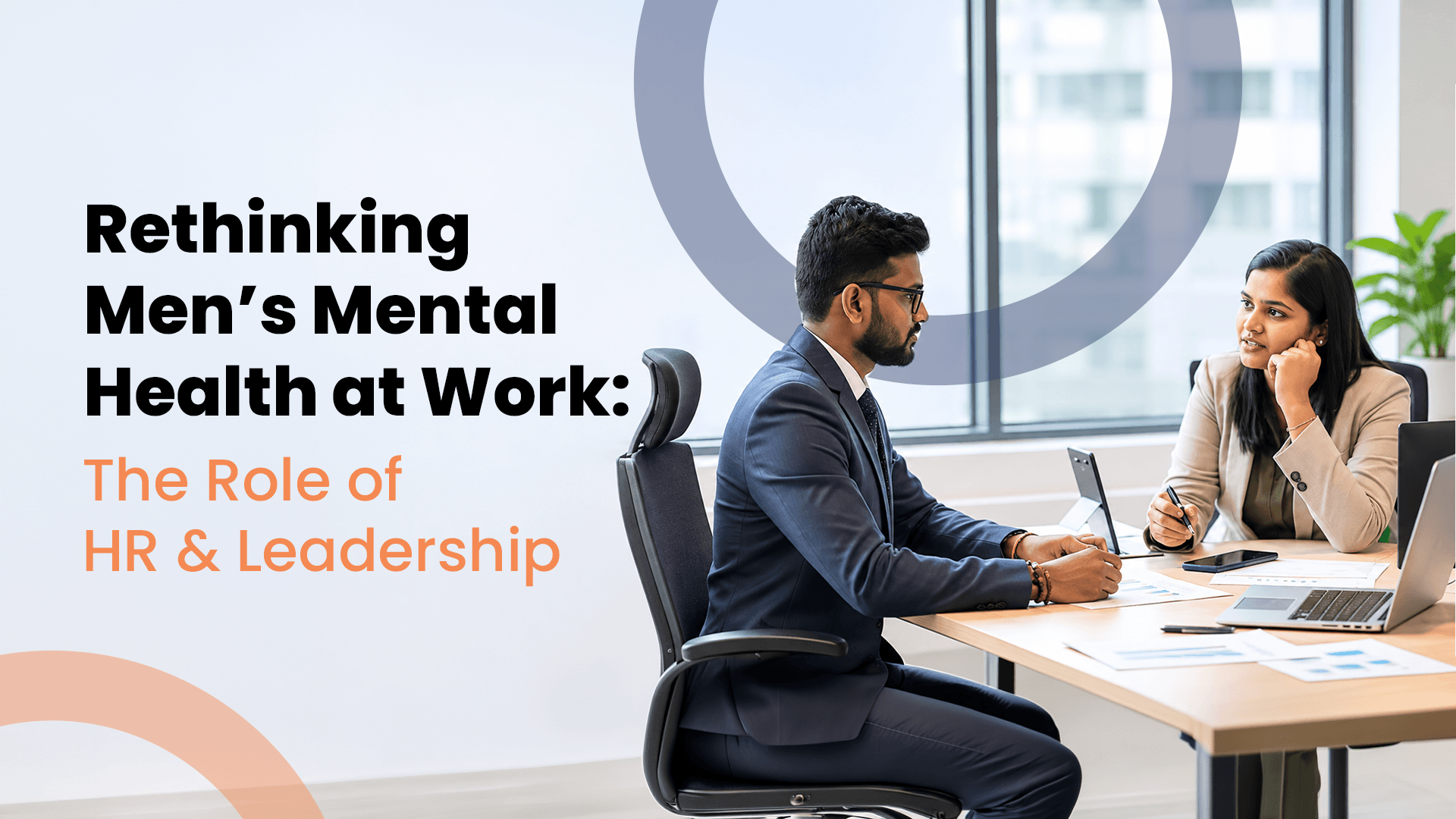
There is a version of the workplace mental health conversation that has become familiar. Organizations launch wellbeing programs, share awareness posts on World Mental Health Day and encourage people to reach out. The language is inclusive. The intent is genuine and yet, when you look at who actually uses those programs, who raises a hand in a check-in, who discloses that they are struggling, men are significantly underrepresented. Not because they are doing fine. Because they have learned, in organizations and in life more broadly, that admitting struggle is not something they are supposed to do.
This is not a personal failing. It is a systemic one. And the responsibility for changing it sits squarely with HR and leadership.
The Numbers Reflect a Real Problem
Globally, men are far less likely than women to seek help for mental health conditions, despite comparable rates of anxiety, depression, and stress-related illness. In workplace contexts, research consistently shows that men are more likely to mask distress, less likely to use Employee Assistance Programs, and more likely to cite performance pressure as a barrier to disclosure.
In India, the picture is compounded by cultural norms around masculinity, provider identity, and the social meaning of professional success. For many men, particularly those in senior roles or in industries where visible stress is read as weakness, the gap between how they are actually doing and how they are expected to appear is significant.
What makes this difficult for HR is that the signal is often invisible. High performance, long hours, and apparent self-sufficiency can all be presentations of distress, not evidence of its absence.
Why Traditional Wellness Programs Often Miss Men
Most workplace wellbeing programs are designed with awareness and access as the primary levers. If employees know the EAP number, if the mental health app is in the benefits stack, the assumption is that the people who need help will use the resources available.
This logic breaks down with men not because resources are unavailable but because the conditions required to use them are not in place.
Disclosure carries perceived cost. In many organizational cultures, a man who says he is struggling risks being seen as less capable, less promotable, or less reliable. This calculus happens privately and rarely gets spoken aloud, but it shapes behavior. The mental health resource sits unused not because the person does not need it but because using it feels like a risk they are not willing to take.
The language of wellbeing does not always land. Much of the vocabulary in workplace mental health, terms like emotional check-in, vulnerability, psychological safety, was developed in a context where women were the primary population engaging with these frameworks. This does not make the concepts less applicable to men. But it does mean that how those concepts are communicated, the metaphors used, the examples given, the framing of what help looks like, may need to shift to reach men who have been taught to relate to their inner experience in different ways.
Programs are opt-in, but culture is constant. A wellness app requires a decision to open it. The team culture that shapes every working hour requires nothing. When the daily environment sends the message that struggle is weakness, opt-in programs are swimming upstream.
What Men at Work Are Actually Dealing With
The specific pressures that show up in men’s mental health at work are worth naming plainly.
- Identity tied to professional performance. Many men, particularly those who grew up with strong provider expectations, experience professional setbacks not just as work problems but as identity threats. A project failure, a missed promotion, or a period of underperformance can spiral into something much heavier than the professional stakes alone would warrant.
- The isolation of leadership. Men who reach senior roles often find that the expectation of having the answers comes with an invisible prohibition on expressing uncertainty or doubt. The person in the room who is supposed to know what to do next does not feel they have permission to say they do not. The loneliness of this position is real, and it compounds over time.
- Masculine norms around help-seeking. There is nothing inevitable about the idea that asking for help is unmasculine. But in many organizational cultures, that association is quietly reinforced, through how weakness is discussed, who gets credit for resilience, what gets labeled as professional. Men absorb these signals and adjust their behavior accordingly.
- Stress that does not get named. Burnout, relationship strain, financial anxiety, grief, and difficulty managing anger can all present as performance issues, disengagement, or interpersonal conflict before they ever get recognized as mental health concerns. By the time they surface, they have often been building silently for months or years.
The Role HR Must Play
HR’s role here is not to become the organization’s therapist. It is to build and maintain conditions in which men feel that seeking support is a legitimate, safe, and professionally neutral choice.
- Make the environment safe before promoting the resource. If your organization’s culture quietly penalizes men who show vulnerability, promoting your EAP on International Men’s Day is not going to move the needle. The first question is not whether people know about the resource. It is whether using it feels safe. That requires cultural work, not communications work.
- Train managers to recognize distress, not just poor performance. The person most likely to notice that a male employee is struggling is their direct manager, and the most common first response is a performance conversation, not a wellbeing check-in. Training managers to recognize behavioral signals, withdrawal, irritability, uncharacteristic errors, presenteeism, as potential wellbeing signals rather than only performance signals is a practical and high-impact intervention.
- Create informal, low-stakes entry points. For many men, the barrier is not access to formal support but the formality of the first step. Peer connection programs, structured manager check-ins that normalize talking about how work is going, men’s group conversations within organizations, and leader-led disclosures where senior men talk about what has been hard for them are all ways of creating lower-stakes entry points.
- Review how you talk about mental health internally. Look at your internal communications, your manager training materials, your wellbeing program design. Who is implicitly centered in the language? What examples are used? How is strength framed? Making the language and framing more resonant with how many men actually experience and talk about difficulty is not a cosmetic change. It is a usability change.
- Use data to surface what the survey cannot. Most engagement surveys are not designed to surface gendered mental health patterns. If you are able to, segment your EAP utilization, your internal counseling referrals, your attrition, and your manager feedback scores by gender. The patterns may tell you something that self-report measures miss.
The Role Leadership Must Play
HR can build programs. HR cannot change culture alone. That requires leadership, specifically visible, consistent behavior from people whose choices shape what the organization implicitly treats as acceptable.
The most powerful intervention available to leaders is modeled behavior. When a senior male leader says, in a team setting, that a period was hard for them, that they sought support, that they are human in the ways that leadership can obscure, it does more for men’s mental health in that organization than any program can. It shifts what is possible to say out loud.
This does not require dramatic disclosure. It can be as simple as a leader saying that they found a recent quarter genuinely stressful, or that they have been working with a coach, or that they took time away and it helped. The specific content matters less than the fact that a person with status and credibility treated their own inner life as a legitimate subject.
Leaders also set the conditions for how pressure is managed. Organizations where leaders celebrate overwork, treat rest as laziness, and implicitly reward presenteeism will produce men, and women, who do not feel permission to acknowledge limitation. The choices leaders make about their own time, their own language, and what they praise are the building blocks of culture.
The DEI Connection
Men’s mental health at work is not separate from the DEI conversation. It is part of it.
Rigid masculinity norms are not only harmful to men. They are part of the same system that marginalizes women, penalizes gender-nonconforming employees, and maintains hierarchies of emotional expression in the workplace. Men who feel permission to be fully human at work are men who are more likely to treat others as fully human. The connection between psychological safety for men and equitable, inclusive workplaces is not coincidental. They are expressions of the same underlying culture.
This is part of why Kelp’s work on DEI training and PoSH compliance addresses culture as a whole rather than identity groups in isolation. The conditions that allow a woman to report harassment safely are related to the conditions that allow a man to say he is struggling. Both require environments where authentic human experience is not professionally punished.
A Practical Starting Point
If you are an HR professional or a leader reading this and wondering where to begin, the following are worth examining now.
Does your organization currently track EAP utilization by gender? If not, that is a gap worth closing. If yes, what does the data show?
Do your managers know how to respond if a male team member discloses that they are not doing well? Not just what resource to refer them to, but how to receive that disclosure in a way that builds trust rather than prompting the person to regret saying anything?
Has any senior male leader in your organization ever spoken openly about mental health difficulty in a way that reached the broader employee base? If not, that absence is itself a signal about what your culture has normalized.
Are your wellbeing programs designed around access, or around the conditions for access? The distinction matters.
Kelp works with organizations across India to build workplaces where people, all people, are able to show up and be supported. If your organization is ready to take men’s mental health at work seriously beyond awareness posts, we would be glad to work with you on what that actually takes.