IN
IN

 USA
USA
 CA
CA
 IN
IN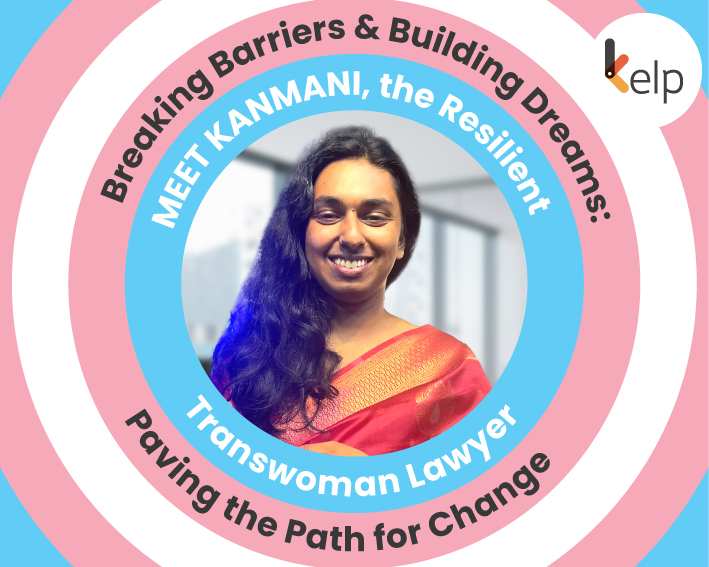
Part 2 – Horizontal Reservation for Transgender Persons
(This article is a continuation to Kanmani’s interview with KelpHR on transgender identities and their existence. Read part 1 here)
The term “horizontal reservation” refers to giving other groups of beneficiaries, such as women, veterans, members of the transgender community, and people with disabilities an equal chance whereas a “vertical reservation” deals with communities at large like reservations for Schedules Castes and Scheduled Tribes, Other Backward Classes, etc.
For instance, in the case of a 50% horizontal quota for women; half of the chosen candidates in each category of the vertical quota must be female, i.e., the chosen candidates in the SC category must all be female, the chosen candidates in the unreserved or general category must all be female, and so on.
While a horizontal quota is not applied uniformly to all vertical categories, it is always applied independently to each of the groupings that are specifically mentioned in the law.
Why Horizontal Reservation?
Kanmani had emphasized the need for Horizontal reservations in order to bring a change in workplaces and educational institutions. The people that we encounter on a daily basis come from a vast group of communities, due to which there are certain stereotypes especially in case a lot of people belong to one community. A walking example of this is Kanmani, who identifies as Savarna transgender person. She hails from a Tamil Brahmin community and acknowledges her caste privilege within the transgender community and has openly stated that she has had better exposure as compared to other trans people from marginalized communities.
According to her, “Until you have horizontal reservations some of the most oppressed and marginalized trans people will not be in the education system, which means they are not making it into workplaces, right?”
If and when horizontal reservation is introduced in the education systems, the opportunity for trans students to join these accredited institutions will be high and can pave the way for the future. Implementing the horizontal reservation policy for employment, as asked by the Supreme Court, and bringing about similar policies in the educational field, would guarantee at least a few opportunities for trans people.
Kanmani identifies this as one of the most critical issues faced by a majority of marginalized groups across the country, because, despite numerous new laws like the Transgender Protection of Rights Act of 2019, and the scenario surrounding the NALSA judgment which recognized the rights of Transgender people, the impact of these is very minimal.
Sharing an anecdote from her life, Kanmani makes it clear such reservations are imperative for everyone to be able to find fair opportunities. Citing her own example, she says that “As recently as 2021, out of the close to 800 students who had studied along with her; she the only openly trans student to have received the LLB degree. However, this was not the case throughout her academic journey.
Whilst having an insightful conversation about her experience with acknowledging the need for horizontal reservation, she says- “I’ve reached where I’ve reached, by lying my way throughout my life. And by lying I meant that the document that I entered the university with and the document that I had when I passed out; my gender was male in the original document and my dead name is still on the document.” (A Dead name is the name a person is born with that they don’t identify with anymore)
She also acknowledges that she owes her knowledge and communication skills to the caste-based privilege and the financial comfort she had growing up; giving her access to experiences she probably would not have had access to if she were not from a privileged background.
She’s also very matter of fact that the products offered by the government for free, such as a tailoring machine, a scholarship of Rs.1,500 a month or any private scholarship with limited accessibility, will not uplift a Transgender person from a repressed background.
“I’m not saying we don’t need private scholarships but what I’m trying to say is, that won’t get a trans person who is highly repressed, into the institution. It won’t open the doors. The only way out is horizontal reservation. I’ve not faced caste based discrimination, I’ve not faced discrimination based on any tribal identity because I don’t have these identities. But there are trans people who have faced caste based discrimination, based on gender, religion, etc. and on the basis that they are Trans gender persons.” she says.
Having extolled Grace Banu for her entry into the engineering field as the first trans woman, Kanmani says that without horizontal reservation, transpersons will have to fight for their admission into an institution.
So, she asks rightfully, “Why not horizontal reservation? You are asking trans people, who have struggled with all of their issues to compete on the same level as CIS people[1] , and trans people who are from oppressed castes and religions and tribal communities to compete with privileged trans people and with others as well. And then we make the cut off, then they’ll be admitted. How is that okay? That’s not okay. That doesn’t mean equality.”
What is the Legal Reality of Horizontal Reservation?
The Karnataka Government is the only government to actively recognize horizontal reservation, to an extent by reserving 1% across all existing categories by horizontal reservation. This term has its own constraints as used in the Indra Sawhney[2]judgment as it stems from the understanding that no person carries a single identity. She reiterates this by using herself as an example as she is someone from an upper caste but belonging to a marginalized section of society as she is a trans woman.
This horizontal reservation has only been extended to jobs and nowhere in the education system, making it lose its purpose as there is no point in trying to secure jobs if there is no adequate education. When transpersons use this reservation to acquire jobs, they could be deemed as incompetent without acknowledging the fact that this was not extended to their education, thereby depriving them of having the right education.
“Trans gender people must be able to access reservation from whichever category they want to apply from, just like reservation and representation of persons with disabilities. The Persons of disabilities Act, 2016 clearly states horizontal reservation. So for persons, even under unreserved category there will be certain seats reserved for persons with disabilities. That is the exact demand being made by transgender people. That we want to be represented in educational institutions, the public sector and even the private sector at some level, at least.” says Kanmani, with acuity and determination.
References: [1] used to describe a person whose gender matches the body they were born with [2] 454_2019_35_1501_29507_Judgement_24-Aug-2021.pdf (sci.gov.in)