IN
IN

 USA
USA
 CA
CA
 IN
IN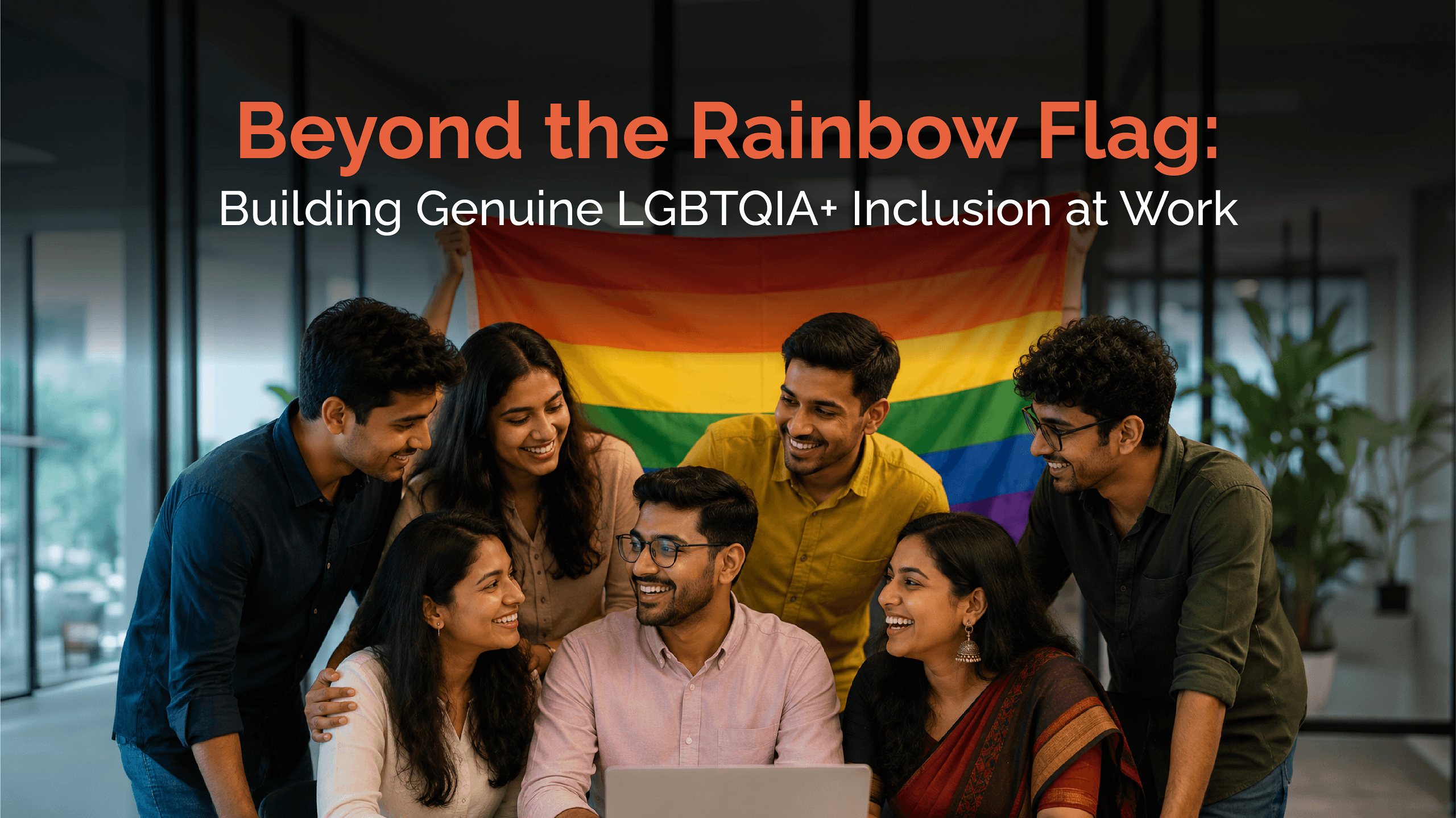
Every June, something predictable happens. Company logos turn rainbow. Inboxes fill with Pride-themed emails. Internal communications are adorned with rainbow imagery. And then, on July 1, most of it quietly disappears.
If you are an HR professional reading this, you may well have been the person behind some of those initiatives, acting in good faith. And beneath the good intentions, you may have sensed something incomplete, in that the activities generated more noise than outcomes, and that the rainbow was more visible than the people it was meant to represent.
That instinct deserves to be taken seriously.
A 2023 YouGov poll found that only 17% of LGBTQIA+ employees believe their companies are genuinely inclusive, despite visible Pride branding. That is a staggering gap between what organisations signal and what their employees experience. It points to a problem that no logo update can fix.
The Rainbow Washing Problem
Rainbow washing refers to the practice of deploying rainbow-themed symbolism in campaigns without any substantive or lasting action to support the LGBTQIA+ community. While corporate Pride campaigns can generate short-term goodwill and positive media coverage, they frequently fail to deliver lasting benefit to the communities they invoke, rendering them tokenistic rather than transformative.
Data from HR Review indicates that 62% of companies run Pride-themed events with no subsequent changes in workplace policy. In the Indian context, where LGBTQIA+ employees already navigate a legal vacuum: no explicit workplace anti-discrimination protections, no recognition of same-sex partnerships, and PoSH Act protections limited to women, the performative corporate gesture is not merely hollow. It can actively erode trust.
The real test lies in whether inclusion is embedded into hiring practices, employee benefits, supplier ecosystems, leadership representation, and long-term community investment. By that measure, most organisations are still at the starting line.
The question HR teams need to ask is not, “What are we doing for Pride Month?” It is: “What are we doing for our LGBTQIA+ employees in every other month of the year?”
Why This Matters Beyond Ethics
There is a business case, and a compelling one, for getting this right, and it is not about public relations.
A World Bank study on India found that anti-discrimination policies and the equitable treatment of LGBTQIA+ employees generate measurable benefits for employers, strengthening the business case for diversity. Stigmatisation and exclusion carry real economic costs, particularly through lost productivity arising from workplace discrimination and hostile work environments.
According to a LinkedIn report, 70% of LGBTQIA+ professionals who participate in ERGs report feeling more connected and supported at work. Belonging drives retention. Retention drives institutional knowledge. And institutional knowledge is one of the few things money cannot quickly buy.
From an ESG perspective, rainbow washing raises pointed questions about a company’s social responsibility and the credibility of its DEI commitments. Investors and stakeholders are applying ever-greater scrutiny to LGBTQIA+ inclusion practices. The organisations that move beyond symbolism are increasingly the ones that attract long-term capital and talent.
What the Legal Landscape Requires, and Where It Falls Short
It is important to be clear-eyed about where India currently stands.
The Supreme Court’s 2018 judgment in Navtej Singh Johar v. Union of India decriminalised consensual same-sex relationships by partially striking down Section 377 of the IPC. It was a landmark ruling, but it was not an employment protection.
The PoSH Act, 2013, India’s primary workplace harassment legislation, defines an “aggrieved woman” and covers sexual harassment against women. It does not explicitly protect LGBTQIA+ employees. While progressive organisations have adopted gender-neutral internal policies that extend PoSH protections to all employees regardless of gender identity or sexual orientation, this is a voluntary act of policy design, not a legal mandate.
The Transgender Persons (Protection of Rights) Act, 2019 provides some protections against discrimination for transgender individuals in employment. However, significant implementation gaps and limited enforcement mechanisms mean that the legislation has not translated into consistent workplace safety for trans employees.
This legislative vacuum has prompted many businesses to take the lead in creating safer, more equitable workplaces for LGBTQIA+ employees through diversity, equity, and inclusion (DEI) programmes.
This is both a challenge and an opportunity. In the absence of statutory minimum standards, what an organisation does for its LGBTQ+ employees is a direct reflection of its values. That is a powerful thing to get right, and a consequential thing to get wrong.
What Real Inclusion Actually Looks Like: A Practical Framework
1. Audit and Upgrade Your Policies: Starting with Anti-Harassment
Your harassment policy should not rely on gendered language that implicitly excludes LGBTQ+ employees. Review your internal PoSH policy and explicitly extend its protections to employees of all gender identities and sexual orientations.
Practical steps:
- Replace “aggrieved woman” with “aggrieved employee” in your internal policy
- Define prohibited conduct to include harassment based on sexual orientation, gender identity, and gender expression
- Ensure your Internal Committee’s mandate is explicitly extended to cover such complaints
- Include LGBTQ+-specific scenarios in IC member training so that members can recognise and respond appropriately to such cases
2. Make Your Benefits Equal
Genuinely equitable programmes span a broad range: equal opportunity in hiring and employment, gender-neutral anti-harassment policies, same-sex partner benefits, adoption leave entitlements, gender-neutral restrooms, community partnerships, and structured mentorship.
Concretely, this means:
- Extending health insurance and group mediclaim benefits to same-sex partners, not just legally married spouses
- Including gender affirming medical procedures in health cover (some Indian companies like Infosys already do this)
- Providing gender neutral restroom access for transgender employees
- Reviewing leave policies (parental, bereavement, and caregiver leave) to be family-inclusive rather than restricted to legally married couples
These changes typically cost less than organisations anticipate. The signal they send is disproportionately valuable.
3. Build Structural Support Through ERGs
An Employee Resource Group for LGBTQIA+ employees and allies is not a feel-good gesture. It is a structural mechanism for surfacing concerns, shaping policy, and building community, and the evidence shows it works.
According to a LinkedIn report, 70% of LGBTQIA+ professionals who participate in ERGs report feeling more connected and supported at work.
For ERGs to function effectively, three conditions are necessary: executive sponsorship from a senior leader who shows up genuinely and consistently; a budget that signals the organisation takes the group seriously; and a formal channel through which ERG input reaches HR policy decisions. Without these foundations, an ERG becomes another checkbox.
4. Train Managers: Specifically and Repeatedly
Recruiters must be trained to identify and mitigate unconscious bias while adopting inclusive hiring practices, including gender-neutral language in job descriptions and structured, criteria-based interviews.
But training cannot stop at recruitment. The line manager is the single most consequential person in any employee’s experience at work. If a manager uses the wrong pronouns, makes assumptions about an employee’s personal life, or treats a disclosure of identity as an awkward moment rather than an act of trust, and inclusion policy on paper means nothing.
Manager training on LGBTQIA+ inclusion should cover:
- Pronoun usage and correct forms of address: how to ask, how to correct yourself, and how to establish inclusive team norms
- Responding to disclosure: what to say and what not to say
- Handling third-party harassment: if a client, vendor, or colleague directs homophobic or transphobic behaviour at a team member, the manager’s response sets the cultural standard
- Recognising subtle exclusion: the jokes that are not really jokes, the assumptions embedded in team conversations, and the dynamics that render some employees invisible in social settings
5. Revisit Hiring and Promotion Processes
Inclusive recruitment and leadership pipelines are essential. A Glassdoor survey found that 76% of job seekers consider workplace diversity a key factor when evaluating companies and job offers.
For LGBTQ+ candidates and employees, the question is not only whether you hire them, but whether they can be visible and authentic once they are in. Review your:
- Job descriptions (remove language that assumes marital or family status; use “you will” rather than gender-specific pronouns)
- Interview processes (include structured questions that assess for inclusive leadership behaviours; remove assumptions about candidates’ personal or family circumstances)
- Promotion criteria (audit whether performance reviews favour traits that LGBTQ+ employees, particularly those who are not yet out at work, are less likely to be credited with)
6. Measure What You Say You Value
Inclusion without data is aspiration without accountability. Consider:
- Adding optional, confidential questions about sexual orientation and gender identity to employee surveys
- Tracking attrition by demographic segment where possible
- Including LGBTQ+ inclusion metrics in manager scorecards
- Benchmarking against frameworks like the India Workplace Equality Index (IWEI), which scores organisations on LGBTQ+ inclusion practices
Organisations that implement inclusive policies, encompassing dedicated hiring platforms, structured job fairs, equitable benefits, and active ally networks, demonstrate a commitment to change that goes beyond symbolism.
What Allyship Looks Like at Every Level
Inclusion is not solely an HR function. It is a leadership posture and a team-level practice.
Executive leadership can determine whether a DEI policy merely exists or actually shapes culture. When a CEO attends Pride events not for the photograph but because their LGBTQIA+ employees will see them there, and that matters. When leaders discuss LGBTQIA+ inclusion in town halls with the same fluency they bring to business results, and that matters. When they remain silent while others say things they should not, and that matters too.
People managers set the daily temperature of psychological safety. They determine whether an employee who comes out as transgender experiences support or isolation. They determine whether homophobic humour is treated as a cultural problem or dismissed as “just a joke.” They determine whether every member of their team has equal access to stretch assignments, visibility, and advocacy.
Individual contributors practise allyship in everyday moments: speaking up when a colleague is misgendered, avoiding assumptions that force disclosure, approaching identity with respectful curiosity rather than intrusive questioning, and using their own privilege to redirect conversations that marginalise others.
Real inclusion is not a June initiative. It is a decision made on an ordinary Tuesday afternoon.
The Pride Month Litmus Test
Here is a practical exercise for HR leaders this June: for every external-facing Pride activity your organisation undertakes, ask whether a corresponding internal commitment exists.
Are you posting a rainbow graphic on LinkedIn? Is your LGBTQIA+ grievance mechanism genuinely accessible and confidential?
Are you sharing statistics about Pride history on Instagram? Do your managers know what to do when someone comes out at work?
Are you distributing Pride merchandise? Do your health insurance policies cover same-sex partners and gender-affirming care?
If external visibility consistently exceeds internal infrastructure, you have a gap worth closing. Genuine inclusion is never a one-off. It is a long-term commitment that requires ongoing effort, honest review, and clear accountability.
Where Kelp Can Help
Most organisations know they need to do more. Fewer know where to start. At Kelp, we work with organisations across India to move LGBTQ+ inclusion from intention to infrastructure — from the Pride post to the policy, from the workshop to the workplace culture that outlasts June.
Our DEI advisory practice covers:
- LGBTQ+ inclusion audits: An honest diagnostic of where your policies, benefits, and practices stand today — and a clear roadmap for where they need to go.
- Gender-neutral harassment policy design: Extending PoSH protections explicitly to all employees, regardless of gender identity or sexual orientation, so your policy reflects your values.
- Manager sensitisation and allyship training: Building the people-manager capability that makes inclusion real at the team level, not just visible in the employee handbook.
- IC member training on LGBTQ+-related complaints: Equipping your Internal Committee to handle cases it has not encountered before, with the rigour, confidentiality, and sensitivity they require.
- Workshops on curiosity harassment, LGBTQ+ workplace rights, and active allyship: Creating awareness and sustained behavioural change at every level of the organisation.
Inclusion is not a June initiative. It is a year-round commitment — to your people, to your culture, and to the kind of workplace where every employee can bring their full self to work and be fairly rewarded for it.
If your organisation is ready to move beyond symbolism, we are ready to help.
Reach out to our DEI team: 🌐 www.kelphr.com | ✉ info@kelphr.com | 📞 95001 29652