IN
IN

 USA
USA
 CA
CA
 IN
IN
Most employees who have experienced workplace sexual harassment know two things: something happened that should not have, and they are not sure what to do about it.
The Internal Committee is the first answer the PoSH Act gives. But what if the employee does not trust the IC? What if she is not sure the IC even exists at her workplace? What if she works in a small organisation, or a household, or an informal arrangement where no IC was ever constituted? What if she has already filed with the IC and nothing has happened?
The government’s answer to those questions is the SHe-Box portal. And while SHe-Box has existed in some form since 2017, most employees and many HR professionals still do not fully understand what it does, who it is for, and how it actually works once a complaint is submitted.
What Is SHe-Box?
SHe-Box stands for Sexual Harassment Electronic Box. It is an online complaint management system developed and maintained by the Ministry of Women and Child Development (MWCD), Government of India.
Originally launched in 2017, the portal underwent a significant relaunch on 29 August 2024, when Union WCD Minister Annapurna Devi formally unveiled a substantially upgraded version. The relaunch introduced centralised IC registration, real-time complaint monitoring dashboards, direct complaint routing to ICs and LCs, and a new compliance repository for employer-submitted annual reports.
SHe-Box today serves three connected functions:
- A complaint channel: enabling any woman covered by the PoSH Act to file a workplace sexual harassment complaint online, regardless of her sector, employment type, or whether she has access to a functioning IC.
- A compliance registry: where employers register their IC details, upload annual reports, and maintain documented records of training and committee constitution, making this information accessible to regulators and courts.
- A monitoring infrastructure: giving the MWCD, District Officers, state governments, and ultimately the Supreme Court a dashboard view of complaint filings, resolution timelines, and employer compliance status across India.
This third function has become increasingly important following the Supreme Court’s landmark 2023 judgment in Aureliano Fernandes v. State of Goa, which flagged “serious lapses” in PoSH implementation nationwide and directed that all ICs be registered and complaint data be maintained centrally. Subsequent Supreme Court orders in December 2024, August 2025, and January 2026 have continued to direct Chief Secretaries to ensure District Officers upload IC and complaint data to SHe-Box making the portal a central pillar of court-mandated compliance infrastructure, not just a voluntary government service.
The portal is accessible at https://shebox.wcd.gov.in
Who Can File a Complaint on SHe-Box?
This is one of the most common questions raised in the ILA–Kelp AMA series and the answer is broader than most people assume.
Any woman covered by the PoSH Act, 2013 can file through SHe-Box. The Act’s coverage is deliberately wide. It applies regardless of age, formal employment status, or sector. Specifically:
- Government employees : central and state government employees across ministries, departments, Public Sector Undertakings, statutory bodies, and autonomous institutions can file complaints against their organisations or respondents within the government system.
- Private sector employees : women working in formal corporate offices, IT/ITeS, manufacturing, retail, hospitality, services, and other private sector workplaces can file through SHe-Box. The complaint is forwarded directly to the organisation’s registered IC.
- Contract workers, interns, apprentices, and consultants : the PoSH Act’s definition of “aggrieved woman” extends to women in non-permanent employment arrangements. They are covered, and SHe-Box is accessible to them.
- Domestic workers :women working as domestic workers, who cannot access an employer’s IC (since households are not required to constitute one), can file through SHe-Box and the complaint is routed to the relevant Local Committee (LC) for the area.
- Unorganised sector workers : including women in agriculture, construction, gig economy arrangements, and informal work. The LC route serves these complainants.
- Women who have already filed with their IC : this is an important clarification from our ILA webinar series. Filing with your IC does not bar you from also filing on SHe-Box. Women who have already submitted a written complaint to their IC are eligible to register the same complaint on the portal as well. SHe-Box then monitors the status of the IC’s action.
A Critical Clarification: SHe-Box Is Not a Replacement for the IC
One of the most important points NCW’s Legal Counsellor emphasised in the March 2026 ILA–Kelp AMA was this: SHe-Box is a complaint channel and monitoring system, not a separate adjudicating body.
When a complaint is filed on the portal, SHe-Box does not conduct its own inquiry. It does not appoint investigators or deliver findings. What it does is route the complaint to the appropriate authority either the Internal Committee of the employer, or the Local Committee and then track what happens next. The IC or LC receives the complaint, conducts the inquiry, and delivers findings under the standard PoSH framework. The portal monitors that the 90-day statutory inquiry window is being respected and that action is being taken. If the workplace’s IC is not yet registered on SHe-Box, the portal notifies nodal officers to ensure timely registration.
This distinction matters for employees: filing on SHe-Box does not shortcut the IC process or guarantee a faster resolution. What it does is create a government-monitored record of your complaint, add accountability to the IC’s handling of the matter, and give you a tracking mechanism for your case status. It also matters for employers: once a complaint is filed on SHe-Box against your organisation, your IC’s handling of that complaint is no longer an internal matter. It is visible to District Officers, state compliance machinery, and in some cases the court’s monitoring system. Delay and non-response become documented, not deniable.
How to File a Complaint: Step by Step
The filing process is straightforward and can be completed from any internet-connected device.
Step 1: Visit https://shebox.wcd.gov.in and click on “Register Your Complaint.”
Step 2: Select your employment category Government Employee (Central or State) or Private Employee. Domestic workers and unorganised sector workers select the appropriate category for LC routing.
Step 3: Provide the required details: your name, contact information, employer details, and a description of the incident. You will need a valid email ID and mobile number.
Step 4: Submit the form. A confirmation message will appear on the homepage and a verification link will be sent to your registered email address.
Step 5: Complete email verification and set a portal password. This gives you access to track your complaint’s status.
Step 6: The portal automatically routes your complaint to your organisation’s IC (for private sector employees) or the relevant government IC/LC. Your IC receives an immediate email notification.
Step 7: Log in to the portal periodically to track the status of your complaint — including whether the IC has acknowledged receipt, commenced inquiry, and disposed of the matter.
What Happens After You File?
Once your complaint is forwarded to the IC, the standard PoSH inquiry process takes over. Here is what should happen:
- Within 7 days: The IC should send you a written acknowledgment of receipt. At this stage, the IC may also offer conciliation an option to resolve the matter before a full inquiry begins. Conciliation can only be attempted at the complainant’s request and is not permitted to involve monetary settlement as the sole resolution.
- If conciliation is declined or fails: A full inquiry commences. The IC issues notice to the respondent, who has the right to submit a written response.
- Within 90 days: The IC must complete its inquiry and submit a written report to the employer with its findings and recommendations. The PoSH Act is explicit on this timeline 90 days is the statutory maximum, not a target.
- Following the inquiry report: The employer must act on the IC’s recommendations within 60 days. Actions may include a written apology, reprimand, warning, suspension, termination, or deduction from salary as compensation to the complainant. The employer cannot simply ignore the report.
- If you are dissatisfied with the outcome: You have the right to appeal the IC’s findings to an Employment Tribunal or the court within 90 days of receiving the inquiry report.
- Monitoring through SHe-Box: Throughout this process, the portal records status updates. If the inquiry is not completed within the statutory window, the nodal officer monitoring the portal is alerted which is precisely the accountability mechanism the Supreme Court has directed be operationalised.
The Employer’s Obligations on SHe-Box
If you are an HR professional or compliance officer reading this, SHe-Box creates obligations for your organisation that go beyond being a passive complaint recipient.
- IC Registration: Your organisation’s IC must be registered on the SHe-Box portal. Multiple state and district authorities — Delhi, Karnataka, Tamil Nadu, and others have issued formal directives mandating this. The Supreme Court has directed this be done nationwide. Non-registration is not a technical oversight; it is documented non-compliance.
- Annual Report Upload: The PoSH Act requires ICs to submit an annual report to the District Officer. SHe-Box provides the mechanism for this. Annual reports should reflect the calendar year and must be uploaded accurately a common error is conflating the reporting year with the upload year.
- IC Member Details: Names, designations, and contact details of IC members must be uploaded and kept current. When an IC member’s term ends or a member changes, the portal record must be updated.
What happens when a complaint is filed against you: When an employee files through SHe-Box, your IC receives an immediate notification. The clock starts from that point. Delayed acknowledgment, a failure to commence inquiry, or breach of the 90-day window all of these become visible to the District Officer’s nodal monitoring system.
On June 12, 2025, the Delhi Department of Women and Child Development formally directed all private organisations and PSUs to register on SHe-Box. Karnataka followed with a compliance notice in August and November 2025. Tamil Nadu issued a state-wide SOP in June 2025 mandating portal compliance and defining consequences including fines of up to ₹50,000 and licence cancellation. The direction of regulatory travel is clear.
Common Questions from the ILA–Kelp AMA Series
The ILA–Kelp AMA webinar series on SHe-Box with NCW’s Legal Counsellor as the expert voice surfaced several questions that recur across organisations of every size and sector. A few of the most common:
“Can an employee file on SHe-Box even if she does not know her IC’s details?” Yes. The portal routes the complaint based on employer details provided during filing. The complainant does not need to know who sits on the IC.
“Does filing on SHe-Box mean the matter becomes public?” No. The complaint is confidential within the portal. Only the IC/LC Chairperson receives the complaint details. The government’s monitoring is of status and timelines — not complaint content.
“What if our organisation is not registered on SHe-Box yet?” The complaint can still be filed. If the IC is not found in the portal, the nodal officer is alerted and directed to ensure registration. This is precisely why non-registration has consequences.
“Can an employee file on SHe-Box and also go to the police?” These are parallel remedies. Filing with the IC or on SHe-Box does not bar criminal proceedings under the Bharatiya Nyaya Sanhita, 2023 (Section 75, which covers sexual harassment). The complainant can pursue both simultaneously.
“What if the IC does not respond after the complaint is forwarded?” This is a documented failure. The nodal officer on the portal monitors response timelines. An IC that fails to acknowledge or commence inquiry within the expected window is in breach of the PoSH Act — and the SHe-Box monitoring system is specifically designed to make that breach visible.
Want to Go Deeper? Join the ILA–Kelp AMA on 25th June
The second session of the ILA–Kelp AMA series on SHe-Box is scheduled for 25th June 2026, 4:00–5:00 PM IST.
This is Part 2 of the conversation that began in March covering the questions that ran over time, the grey areas that need deeper discussion, and the specific implementation challenges that IC members and HR professionals are navigating on the ground. NCW’s Legal Counsellor will be joining the session as the subject matter expert.
If you work with an Internal Committee, handle PoSH compliance, or advise organisations on workplace safety this is the conversation to be in.
🔗 Register here: https://bit.ly/4vDLH6E
How Kelp Can Help
SHe-Box is one piece of a larger PoSH compliance framework and understanding how the portal interacts with your IC, your annual report obligations, and your grievance mechanism is something many organisations are still working through.
At Kelp, we help organisations:
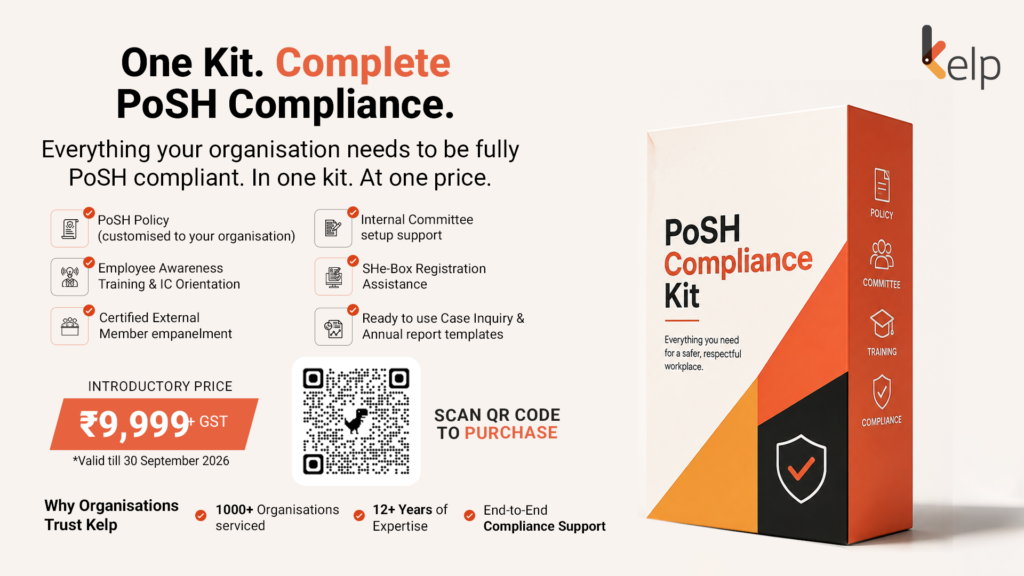
- Register and maintain their IC on SHe-Box correctly, completely, and with current member details
- Train IC members on how SHe-Box complaints differ from direct complaint filings and what the portal-based process requires from them
- Conduct PoSH audits that include SHe-Box compliance as a verified checklist item
- Prepare annual reports that meet both the PoSH Act’s requirements and the portal’s upload specifications
- Run employee awareness sessions so that women in your organisation know SHe-Box exists, how to access it, and what to expect
A complaint filed on SHe-Box is now a monitored record in a government system watched by District Officers, state compliance machinery, and in some cases the Supreme Court. Your IC’s handling of it will be measured against a statutory clock. The organisations that are prepared for that are the ones that will respond with competence and confidence when it matters most.
Reach out to our team at www.kelphr.com | info@kelphr.com | 95001 29652