IN
IN

 USA
USA
 CA
CA
 IN
IN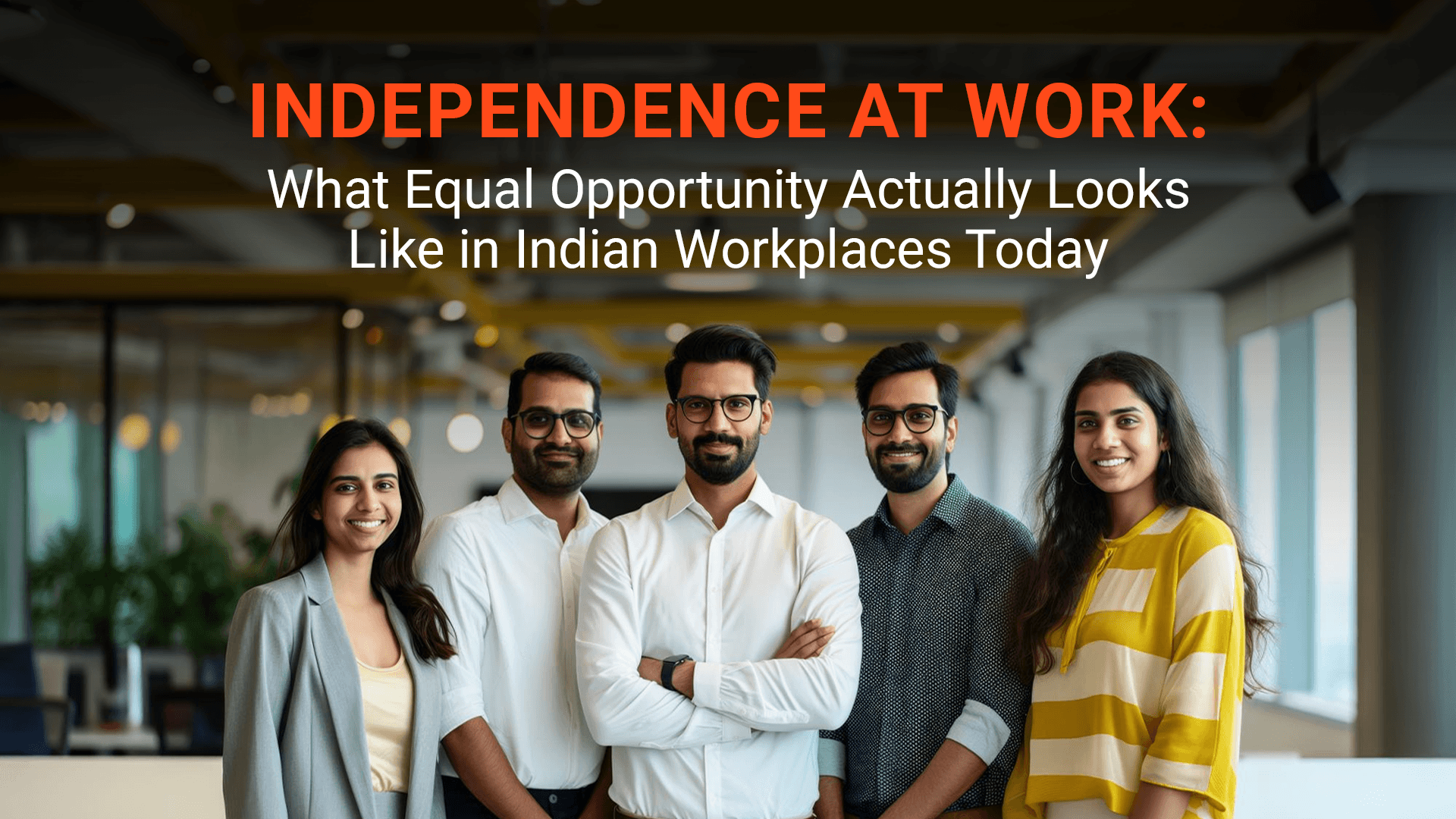
Every year on August 15, Indian organisations put out something. A post about freedom. A note from the CEO about unity in diversity. A flag hoisting photograph from the office terrace andd every year, the distance between what those posts say and what the data shows stays roughly the same.
India’s Constitution promised equal opportunity in 1950. The Equal Remuneration Act codified it in 1976. The Rights of Persons with Disabilities Act strengthened it in 2016. The PoSH Act built a floor of safety in 2013. The legal architecture is there.
What is not yet there is the workplace that those laws describe.
Independence Day is a moment worth using honestly. Not for flag-waving content. Not for aspirational quotes that cost nothing to publish. But for a clear-eyed look at where equal opportunity in Indian workplaces actually stands, what the data shows, where the gaps are real and documented, and what organisations can do that goes beyond the annual post.
What the Constitution Actually Promised
Articles 14, 15, and 16 of the Indian Constitution guarantee equality before the law, prohibit discrimination on the basis of religion, race, caste, sex, or place of birth, and ensure equal opportunity in employment. These are not aspirational statements. They are foundational legal commitments.
Article 39(d) goes further, directing the State to ensure that there is equal pay for equal work for both men and women, a directive principle that the Supreme Court has repeatedly affirmed as enforceable.
This framework is over seventy years old. The question worth asking on Independence Day is not whether these principles exist. It is whether the Indian workplace has chosen to honour them.
The Gender Gap: Strong on Paper, Persistent in Practice
The legal case for gender equality in Indian employment is comprehensive. The Equal Remuneration Act, 1976 prohibits gender-based discrimination in wages, hiring, and employment conditions. The Companies Act, 2013 mandates at least one woman director on the boards of qualifying listed companies. The PoSH Act, 2013 provides every woman with a right to a harassment-free workplace. The Maternity Benefit Amendment Act, 2017 extended paid maternity leave and added creche obligations for larger employers.
The data tells a different story.
As of 2024, women hold just 18.67% of all board positions in listed Indian companies, according to Ministry of Corporate Affairs data. In operational leadership roles, including CEO, CFO, and COO positions, that figure drops to 14.08%. Women comprise nearly a third of India’s technology workforce, yet the gender pay gap in IT services stands at 18.3% overall and reaches 22.2% in high-demand tech roles. Salaried men in India earned approximately 1.2 times more than salaried women in the 2023-24 PLFS cycle, and the self-employment gap was starker still, with men earning roughly three times what self-employed women earned.
India ranked 131st in the World Economic Forum’s Global Gender Gap Index 2025, down from 129th the previous year. At the current pace of change, analysts estimate that closing the overall gender gap in India will take over 130 years.
The gap between the legal framework and these numbers is not a mystery. Research consistently identifies the mechanisms: occupational segregation that concentrates women in lower-paid roles, promotion patterns that stall at the middle-management level, performance assessment language that encodes gender bias, and the structural weight of unpaid care responsibilities that falls almost entirely on women and is never accounted for in how “high performance” or “potential” are defined.
None of these mechanisms appear in the law. All of them shape outcomes.
The Disability Gap: Compliance on Paper, Exclusion in Practice
The Rights of Persons with Disabilities Act, 2016 is one of the most comprehensive disability rights statutes India has produced. It expanded recognised disabilities from 7 to 21 categories, mandated 4% reservation in government establishments, required reasonable accommodations in both public and private sector workplaces, and affirmed that the principle of reasonable accommodation captures a positive obligation to facilitate full and effective participation.
The implementation picture is considerably more modest.
Data from NIUA research on urban disability employment found that the total labour force participation rate of persons with disabilities in urban India is approximately 21.9%, nearly a third of the participation rate of persons without disabilities. Of the 4% government quota, only around 1% is actually filled in practice. The private sector faces no mandatory reservation requirement, only a non-discrimination obligation and an incentive under Section 35 of the RPwD Act to employ at least 5% of the workforce from persons with disabilities, an incentive that has not translated into material change at most organisations.
In February 2025, 155 private and government organisations were penalised for non-compliance with the digital accessibility mandates of the RPwD Act. Physical inaccessibility remains widespread. And according to a UNDP India report, despite approximately 50% of corporates reporting policies for disability inclusion, implementation remains weak due to inadequate infrastructure, insufficient training, and persistent stereotypes.
Failing to build a disability-inclusive economy, according to research cited by that UNDP report, could cost India over USD 210 billion.
The business case, the legal case, and the ethical case all point in the same direction. The practice has not caught up.
The Safety Gap: The Floor That Not Everyone Can Access
The PoSH Act is sometimes treated as a separate topic from equal opportunity. It should not be. Safety at work is a precondition for equal opportunity. A woman who does not feel safe at her workplace, or who knows that complaints are not taken seriously, or who has experienced harassment without recourse, is not operating on a level field regardless of what the pay band says.
The Supreme Court’s description of PoSH implementation in the private sector as “lamentable” in the Aureliano Fernandes v. State of Goa directions captures something real. Annual compliance rates on IC formation, training requirements, and annual reporting remain uneven, particularly in smaller private sector organisations and in the informal economy. Workers in gig and platform arrangements, growing from an estimated 7.7 million in 2020-21 to approximately 12 million by 2024-25, exist almost entirely outside the Act’s practical reach.
For women in sectors where daily work brings them into contact with clients, vendors, customers, and contractual colleagues, the boundary of who is covered and who has recourse to what is often genuinely unclear. Equal opportunity cannot be separated from the question of whether those exercising it feel safe enough to do so.
The Structural Gap: What “Opportunity” Assumes and What It Actually Requires
There is a version of equal opportunity that is entirely formal. It says: we do not discriminate. We hire on merit. We promote on performance. Our doors are open.
That version of equal opportunity is incomplete because it assumes everyone arrives at the door from the same position. They do not.
Two candidates with identical qualifications on paper may have arrived there through entirely different amounts of structural support. One had parents who could explain how a corporate interview works. One attended an English-medium school in a city. One had family connections who could make a phone call. One had the economic safety net to take an unpaid internship. One grew up understanding the unwritten rules of professional environments.
The research on first-generation professionals, those who are the first in their families to enter corporate employment, is consistent on this point. A Boston Consulting Group study found that first-generation professionals are nearly 50% less likely to have access to the career-navigating networks that their continuing-generation peers take for granted. They are less likely to know about positions filled through referrals. They are less likely to have been coached on salary negotiation. They are more likely to misread the informal signals of performance and visibility that determine who gets noticed.
None of this is captured by the phrase “equal opportunity.” All of it shapes who actually gets the opportunity.
What the August DEI Theme Has to Do With This
This month’s DEI theme, “Where we come from shapes how we work,” is exactly right as an invitation to think about this honestly.
Where we come from shapes what language we present in, what confidence we carry into a room, whose name we can drop to establish credibility, what we know about navigating professional systems, and what we can absorb in terms of risk without the safety net that structural advantage provides.
The Access Ladder exercise, which surfaces dimensions like schooling access, network access, language safety, and physical and psychological safety, makes these structural starting points visible. It does not require anyone to announce a protected identity. It asks people to locate themselves within a structural picture that most organisations never make explicit.
Doing this honestly on or around Independence Day is worth something beyond the symbolic. Because the freedom the day commemorates was not just about political independence. It was, in the words of the Constituent Assembly debates, about building a society where every individual could exercise their rights and develop their capacities without the restrictions of birth, belief, or circumstance constraining what was possible for them.
The workplace is one of the primary spaces where that promise is either kept or quietly set aside.
What Equal Opportunity Actually Requires: A Practical List
Organisations that want to move from formal commitment to real equal opportunity need to examine six things specifically.
- Pay transparency and audit. Without structured pay band transparency and periodic pay equity audits, equal pay for equal work remains a principle without a mechanism. Audits should cut across gender, level, and where data allows, socio-economic background. They should look for patterns, not just individual instances.
- Promotion criteria that are explicit and observable. Most promotion decisions in Indian organisations involve a combination of formal performance data and informal judgement. The informal judgement is where bias concentrates. Making promotion criteria explicit, defining what “leadership potential” looks like in measurable terms, and requiring multiple assessors for promotion decisions reduces the surface area for bias without removing discretion.
- Reasonable accommodation that is real, not performative. The RPwD Act’s requirement for reasonable accommodation is a legal obligation in the private sector, not a favour. Organisations need a designated person responsible for accommodation requests, a process for assessing and responding to them, and a culture that treats accommodation as a design problem rather than a burden.
- Parental and caregiver policy that treats care as shared. Organisations that offer robust maternity leave but minimal paternity leave are encoding the assumption that caregiving is a woman’s responsibility. This directly shapes who gets interrupted careers, who gets passed over for stretch assignments, and who gets stuck at middle management. Shared parental leave, flexible return-to-work arrangements, and visible senior men using parental leave are all part of what equal opportunity requires.
- Safe and accessible complaint mechanisms. A harassment-free workplace is not optional. Neither is an accessible, functional IC with trained members, a complaint process that people actually trust, and consistent follow-through on outcomes. Organisations that treat PoSH as a compliance activity separate from equal opportunity are missing that the two are inseparable.
- Mentorship and sponsorship that reaches first-generation professionals. The informal networks that accelerate careers are not available equally. Structured mentorship programmes, sponsorship by senior leaders who actively advocate for high-potential employees who would otherwise be invisible, and transparent communication about what career advancement actually requires are equalising mechanisms that organisations can build deliberately.
The Honest Framing for Independence Day
India’s Independence Day invites reflection on what freedom is actually for. The founders of the Republic understood that political independence without social and economic equality was incomplete. They built the constitutional framework accordingly.
The gap between that framework and what most Indian workplaces practise today is not a secret. It is documented, measured, and reasonably well understood. What changes it is not another post about unity in diversity. What changes it is the decision to audit the pay data, train the IC, examine the promotion patterns, make the accommodation process real, and design the professional development programmes to reach the people they currently miss.
Equal opportunity is not a slogan. It is a set of specific choices that organisations make or fail to make every year. August 15 is as good a moment as any to be honest about which choices yours has been making.
How Kelp Can Help
Kelp works with organisations across India to build the structures that equal opportunity actually requires. Our work spans PoSH advisory and training, IC member certification, DEI strategy and facilitation, Culture Sensitization workshops, and inclusive leadership programmes. We help organisations move from stated commitments to documented, auditable practice.
If your organisation is ready to use this Independence Day as a genuine inflection point rather than a content calendar moment, we would welcome the conversation.
Reach us at info@kelphr.com, call 95001 29652, or visit www.kelphr.com.