IN
IN

 USA
USA
 CA
CA
 IN
IN
Ask any HR manager in India whether their organization is PoSH-compliant. 90% of the time, the answer is yes.
Ask them the follow-up questions and the certainty begins to thin.
Does your IC have an external member? Has the external member attended a meeting in the last six months? Was your annual report submitted to the District Officer, not just filed internally? Do your employees know what constitutes sexual harassment under the law, not just that a policy exists? Can your IC produce written documentation of every complaint received, including complaints that were informally withdrawn?
PoSH compliance in India is one of the most confidently misunderstood legal obligations in the corporate world. Companies form an Internal Committee, draft a policy, and conduct one training session. They check a few boxes and call it done.
The law, and the state-level enforcement mechanisms that have grown up around it, requires considerably more.
What “Compliant” Actually Means Under the PoSH Act 2013
The Sexual Harassment of Women at Workplace (Prevention, Prohibition and Redressal) Act 2013 creates a multi-layered compliance obligation. It is not satisfied by forming a committee and printing a policy. Full compliance requires ongoing action across four distinct areas: structure, training, process, and reporting.
Most organizations are partially compliant in one or two of these areas and either unaware of or ignore the rest. This matters because PoSH penalties are levied for procedural non-compliance, even in the complete absence of any complaint.
Under the Act, penalties of up to ₹50,000 apply for:
- Failing to constitute a properly formed IC
- Failing to act on an IC recommendation
- Failing to file the Annual Report with the District Officer
- Repeat violations can lead to licence suspension or cancellation
State labour departments have become increasingly active in PoSH audits, particularly in Maharashtra, Karnataka, Tamil Nadu, Delhi NCR, and Telangana. The PoSH compliance environment is no longer one where inaction carries no consequence.
The Four Pillars of PoSH Compliance: Where Most Companies Fall Short
Pillar 1: Structural Compliance
This is the pillar most organizations believe they have covered. The IC is formed. The policy exists. But structural compliance goes deeper than formation:
IC composition: The IC must be presided over by a senior woman employee. It must include at least two other employees and one external member who is a PoSH expert, lawyer, NGO worker, or person with relevant experience. Is your external member actually qualified and active?
IC member rotation: The IC members’ appointment is for a fixed term. Many organizations forget to renew the appointment, leaving the IC technically invalid.
Multi-location compliance: If your organization operates across states or has multiple offices, each establishment may require its own IC. A single IC at headquarters does not cover branch offices in other cities or states.
Contractual and gig workers: The Act covers women at the extended workplace, including contractual staff, interns, and freelancers. Your IC must be equipped to receive and process complaints from these categories, not just permanent employees.
Pillar 2: Training Compliance
The Act mandates training “at regular intervals”. A single annual session does not satisfy this requirement. Best practice, and the standard adopted by most state audit frameworks, is quarterly training for employees and structured programme-based training for IC members.
Two categories of training are legally distinct and both are required:
- Employee and manager awareness training: What constitutes sexual harassment, how to report it, what happens after a complaint is filed.
- IC member training: The inquiry process, confidentiality obligations, documentation standards, natural justice principles, and handling complex cases.
Many organizations conduct only employee awareness training and assume IC members will figure out the rest. This is both legally insufficient and operationally dangerous, as the first blog in this series covered in detail.
Pillar 3: Process Compliance
Even organizations with a functioning IC often have process gaps that only become visible when a complaint arrives:
No written complaint mechanism: The Act requires a formal, documented process for filing complaints. A verbal complaint to HR is not the same as a complaint received by the IC.
No written acknowledgement protocol: Every complaint, including complaints that are resolved informally or withdrawn, must be acknowledged in writing. IC members often skip this step.
Conciliation confusion: Conciliation is only permissible at the written request of the complainant and only in cases that do not involve a monetary settlement. It cannot be offered as a default alternative to inquiry.
No retaliation monitoring: The Act prohibits retaliation against complainants, witnesses, and anyone who provides information. Without a defined monitoring mechanism, retaliation goes undetected and unreported.
Confidentiality breaches: Information about any complaint, parties, or proceedings cannot be communicated to the press, public, or to individuals within the organization who are not part of the IC. Many organizations routinely violate this without realising it.
Pillar 4: Reporting Compliance
The Annual Report is one of the most commonly missed compliance requirements. Under Rule 14 of the PoSH Rules, the IC must prepare an annual report and submit it to the employer, who in turn must file it with the District Officer.
The report must include the number of complaints received, nature of complaints, cases disposed, cases pending, awareness and training sessions conducted. Filing a report only internally, without submitting it to the District Officer, is non-compliance.
The recommended filing window is by 31 January, covering the prior calendar year, though the law does not specify a fixed date. Many organizations miss this entirely, filing nothing at all.
State-Wise PoSH Compliance: Why Location Matters More Than You Think
PoSH compliance is a central law, but enforcement is a state-level responsibility. This creates meaningful variation in how compliance is audited, what documents are requested, and how penalties are applied. Organizations operating across multiple states face compounded compliance requirements.
Key state-level differences to be aware of:
- Maharashtra: Among the most active states in PoSH enforcement. District Officers in Mumbai and Pune have conducted employer audits requesting IC constitution orders, training records, and annual reports. The Maharashtra Government has also issued specific circulars on PoSH compliance for government establishments, setting a precedent for private sector expectations.
- Karnataka: Bangalore’s high concentration of IT and BFSI employers has made it a focal point for PoSH audits, particularly following high-profile workplace harassment cases in the tech sector. Labour department officials have been increasingly proactive in requesting compliance documentation from listed companies.
- Tamil Nadu: Chennai’s manufacturing and IT/ITES clusters face dual compliance scrutiny under PoSH and sector-specific labour regulations. External members serving across multiple organizations in the same geography can create conflict-of-interest issues that state auditors flag.
- Delhi NCR: With the highest concentration of MNC headquarters, Delhi NCR sees frequent compliance checks. The SHe-Box portal, which allows women to file PoSH complaints directly with the government, has increased government visibility into private sector compliance across Delhi organizations.
- Telangana and Andhra Pradesh: Hyderabad’s pharma and IT sectors have seen growing PoSH audit activity. The bifurcated state structure means organizations with offices on both sides of the state boundary need separate compliance documentation for each jurisdiction.
If your organization operates in more than one state and uses a single, centralised IC, you are almost certainly non-compliant in at least some of those locations. A state-wise PoSH audit is not optional for multi-location businesses. It is the baseline for understanding your actual compliance position.
Kelp’s PoSH State-Wise Audit: What It Covers
Kelp’s PoSH Audit service is a structured compliance assessment that maps your organization’s actual PoSH position against both the central Act and the relevant state-level requirements in each jurisdiction where you operate.
The audit covers:
- IC constitution review: composition, qualifications, appointment letters, terms, and active status of all members including the external member
- Policy review: whether the policy language is clear, legally current, accessible to all employees in the languages they use, and actually known to the workforc
- Training records: frequency, coverage, documentation, and IC-specific vs employee-level training differentiation
- Complaint process review: written mechanisms, acknowledgement protocols, confidentiality procedures, and grievance register
- Annual report audit: whether reports have been filed, with whom, and in the correct format for each state
- State-specific compliance gap mapping: identifying requirements that differ by state and flagging locations that need additional action
- Recommendations with prioritisation: immediate gaps, medium-term fixes, and structural improvements with suggested timelines
The output is a written compliance report that gives your organization a clear, state-by-state picture of where you stand and what needs to change. For organizations facing a government audit, this report also serves as evidence of good-faith compliance effort.
The PoSH Compliance Kit: For Organizations That Want to Close the Gaps Themselves
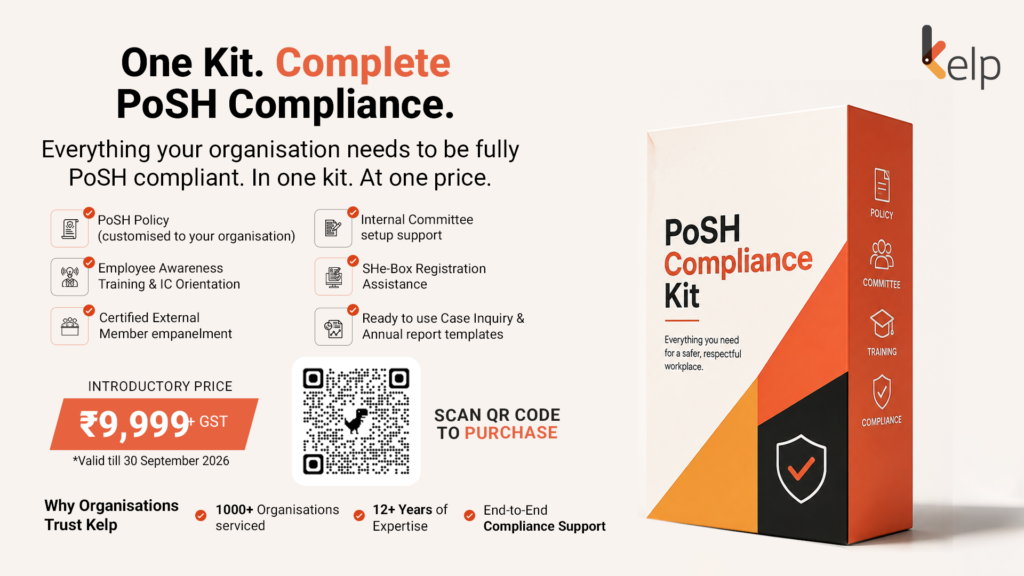
For organizations that already have an audit picture and want to address the gaps efficiently, Kelp’s PoSH Compliance Kit is a structured, ready-to-deploy resource set that eliminates the documentation and process gaps that most non-compliant organizations share.
The Kit contains everything an organization needs to achieve end-to-end PoSH compliance without starting from scratch:
- A legally current PoSH Policy template, ready for customisation and adoption
- IC constitution templates including appointment letters, terms of reference, and the external member agreement
- Complaint registration and acknowledgement templates
- IC meeting agenda and minutes templates
- Annual report template in the format required for District Officer submission
- A PoSH Compliance Checklist covering all four compliance pillars across structural, training, process, and reporting requirements
- Guidance on state-level filing requirements for Maharashtra, Karnataka, Tamil Nadu, Delhi NCR, and Telangana
The PoSH Compliance Kit is available at ₹9,999 + GST and is designed for HR teams that need to systematise their PoSH compliance without committing to a full advisory engagement.
For organizations that need expert support in implementing the Kit, or that want Kelp to run the compliance review directly, the Audit service provides that end-to-end layer.
The Actual PoSH Compliance Checklist: 20 Questions Your Organization Must Be Able to Answer
Run through these before your next board review, before a government audit, and before you tell anyone your organization is PoSH-compliant.
IC Structure
- Is your IC presided over by a senior woman employee?
- Does your IC have at least two other members from your employees?
- Is your external member currently active, qualified, and within their appointment term?
- If you have offices across states or cities, does each establishment have its own IC?
- Does your IC have at least 50% women members, including the Presiding Officer who must be a senior woman employee? oes your IC include representation for contractual and non-permanent employees?
Policy and Awareness
- Is your PoSH policy current, reviewed in the last 12 months, and accessible to all employees?
- Is the policy displayed at a prominent place in the workplace as required by the Act?
- Do all employees know what constitutes sexual harassment under the law, not just that a policy exists?
- Have managers and IC members received separate, targeted training in the last 12 months?
- Can you produce attendance records for all training sessions conducted in the last year?
Process and Documentation
- Does your organization have a documented, written mechanism for filing a PoSH complaint?
- Does the IC acknowledge every complaint in writing on priority?
- Does the IC send a written notice to the respondent with the complaint details within the required timeframe?
- Is there a confidentiality protocol that all IC members have been briefed on?
- Does your organization have a defined process for identifying and reporting retaliation?
Reporting
- Has your IC prepared an annual report for every calendar year since its formation?
- Has the employer filed the annual report with the District Officer, not just kept it internally?
- Does the annual report include the required data: complaints received, nature, disposed, pending, awareness sessions held?
- If your organization operates across states, has a report been filed with the District Officer in each relevant jurisdiction?
- Does the employer securely maintain records of IC proceedings, complaints, inquiry documentation and related correspondence for at least seven years, or longer where required under the organisation’s record-retention policy or applicable law?
If you answered no or not sure to five or more of these questions, your organization has material compliance gaps. If you answered no or not sure to ten or more, you are carrying meaningful legal exposure.
Compliance Is Not a One-Time Event
PoSH compliance is an ongoing obligation, not a project with a completion date. The Act requires annual training, annual reporting, active IC maintenance, and a living complaint process. Organizations that treat it as a box to check and move on create a compliance gap that compounds with each passing year.
State labour departments are not waiting for a complaint to investigate. They audit proactively. And when they find gaps, including a lapsed external member appointment or a missing District Officer submission, the penalty falls on the employer, not the employee who was supposed to manage it.
The question is not whether your organization means to be compliant. The question is whether it actually is.
Start With a PoSH Audit. Close With the Compliance Kit.You can also directly purchase the PoSH Compliance Kit.