IN
IN

 USA
USA
 CA
CA
 IN
IN
Someone raises a toast at the annual offsite. Three drinks in, a joke lands badly. The next morning, HR gets a call. Does this even count? It happened at a resort after work hours, nowhere near anyone’s desk.
Most HR teams still answer that question the way they’d answer it in 2014, by checking whether the incident happened inside office walls. That instinct is exactly what is now getting employers into legal trouble.
The Prevention of Sexual Harassment Act, 2013, was never written to protect only the four walls of an office. Section 2(o) of the Act defines “workplace” in intentionally expansive terms, and over the last few years, courts across India have been steadily closing every loophole that treated “workplace” as a physical address rather than a legal relationship. For HR leaders and Internal Committee (IC) members, understanding where the Act’s protection actually starts and stops is no longer a nice-to-have. It is the difference between a valid inquiry and one that collapses on a jurisdictional technicality.
The Legal Starting Point: What Section 2(o) Actually Says
The PoSH Act defines “workplace” to include far more than a registered office address. It covers any place visited by an employee arising out of or during the course of employment, including transportation provided by the employer for undertaking such a journey. That single clause is doing a lot of work: it is the reason company cabs, off-sites, business travel, and work-related social events all fall within scope.
Courts have consistently declined to draw a neat boundary around this definition. In a widely cited 2020 ruling, the Sikkim High Court held that the ambit of ‘workplace’ cannot be reduced to an exhaustive list. It must instead be determined by the Internal Committee based on the facts and evidence placed before it. In other words, there is no checklist that tells you in advance whether a resort, a client’s premises, or a WhatsApp group qualifies. The IC has to make that determination each time, grounded in whether the incident arose out of or during the course of employment.
Five Places the Workplace Has Already Been Tested in Court
- The office party and the offsite.
Corporate retreats, conferences, training sessions, and team celebrations are consistently treated as extensions of the workplace. The reasoning is simple: these events exist because of the employment relationship, are usually organised or funded by the employer, and employees typically cannot opt out without professional consequence.
- The company car and the daily commute.
Transport arranged by the employer is explicitly named in the Act’s definition of workplace. This has real operational consequences: employers running cab services, especially for late shift or night-shift staff, are expected to have safeguards such as driver verification, GPS tracking, and a clear reporting channel for incidents inside the vehicle.
- The client site and the shared workspace.
Employees deployed at a client’s office, a co-working space, or a vendor’s premises remain covered by their own employer’s PoSH obligations, even though the alleged harasser may not be their colleague. This is where third-party harassment provisions come in. The Act requires employers to take action even when the perpetrator is a client, customer, or vendor, not just a fellow employee.
- The WhatsApp group and the late-night email.
Digital spaces are not a grey area anymore. In the case of Sanjeev Mishra v. The Disciplinary Authority and General Manager, Bank of Baroda (2021), the Rajasthan High Court held that online messages which are sexual in nature and unwelcome can constitute workplace sexual harassment regardless of the physical distance between the parties involved. A hostile comment in a work Slack channel or an inappropriate message sent over a late-night WhatsApp thread can meet the same legal threshold as an in-person incident, provided it arises out of the employment relationship
- The event that looks entirely personal, until it isn’t.
Even a wedding reception has been examined by a High Court for its connection to employment. In a case involving Sikkim University, a professor’s termination followed allegations at a wedding reception, and the court’s review turned on whether that setting could reasonably be linked to the employment relationship. The lesson for HR teams: the test is not the venue. It is the connection between the incident and the person’s employment.
Where the Definition Has a Limit
Expansion is not the same as infinite scope, and Kelp’s advisory work is grounded in mapping the law accurately rather than treating every setting as automatically covered. In 2025, the Supreme Court declined to extend the PoSH Act to political parties, holding that a party cannot be equated with a workplace because membership does not create an employment relationship. There is no appointment, no salary, and no employer-employee structure to anchor jurisdiction. The courts keep returning to his: workplace status depends on whether an employment relationship exists and whether the incident arose out of or during the course of that employment, not merely on whether the setting feels work-adjacent.
This is exactly why IC members cannot rely on instinct or a fixed list. Two similar-looking events, a purely social gathering with no employer involvement and a company-sponsored offsite, can land on opposite sides of the line.
Why This Matters Right Now
Judicial scrutiny of PoSH Act implementation has intensified sharply over the past year, with the Supreme Court pushing for nationwide, district-wise compliance verification and reinforcing that jurisdictional technicalities cannot be used to deny a complainant access to redress. A 2025 by Apex court ruling went further, holding that a woman can approach the Internal Committee at her own workplace even when the person she is complaining against belongs to a different organisation entirely, directly relevant to the client-site and vendor scenarios above.
For employers, the practical risk is no longer just the ₹50,000 fine for non-compliance. It is an IC that dismisses a legitimate complaint on the grounds that “it didn’t happen in the office,” only to have that finding overturned or the organisation exposed to regulatory action for an improperly conducted inquiry.
What HR Teams and IC Members Should Actually Do
- Update your PoSH policy language. If your policy defines “workplace” narrowly or lists only the registered office address, it needs to be rewritten to mirror Section 2(o) explicitly, covering offsites, client premises, company transport, and digital platforms.
- Brief your IC on jurisdiction, not just procedure. Most IC training focuses on how to conduct an inquiry. Equally important is training the Committee to correctly determine whether an incident falls within scope in the first place, using the “arising out of or during the course of employment” test rather than a location checklist.
- Extend safeguards to offsites and company transport in practice, not just policy. This means a visible point of contact at every offsite, verified transport arrangements, and a reporting mechanism that works even when the incident happens outside a formal office setting.
- Build clear agreements with clients and vendors. Where employees are regularly deployed at a client’s premises, put a shared understanding in place for how complaints involving third parties will be handled and by whom.
- Do not assume digital conduct is out of scope. Messaging platforms, virtual meetings, and after-hours communication tied to work all fall within the Committee’s jurisdiction if the conduct arises from the employment relationship.
The Bigger Shift
The question employers should be asking is no longer “did this happen at the office?” It is “did this arise out of or during the course of employment?” That single reframe changes how policies are written, how ICs are trained, and how seriously an offsite party, a company cab, or a client meeting needs to be treated.
This is precisely the question Kelp and ILA are unpacking in our upcoming session, “Expanding the Definition of ‘Workplace’ Under PoSH,” on 30 July 2026. If you are responsible for PoSH compliance, policy language, or IC training at your organisation, this is a session worth putting on the calendar. Reserve your seat, and bring your toughest jurisdiction questions.
Need help getting your PoSH policy and IC aligned with the current legal definition of “workplace”? Kelp works with organisations across India to build compliance frameworks that hold up under scrutiny, not just on paper.
📩 info@kelphr.com | 📞 95001 29652 | 🌐 www.kelphr.com
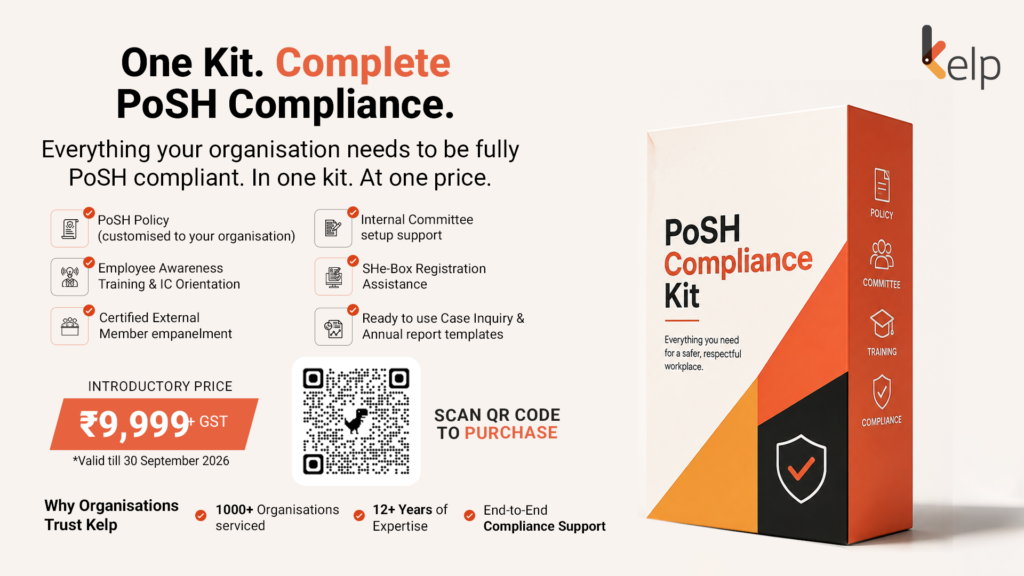
Ready-to-use PoSH Compliance Kit for MSME’s and smaller companies
If you’re a small organisation trying to implement PoSH compliance without an HR team or the necessary resources, we’ve made it simpler. Our PoSH Compliance Kit brings together everything you need in one ready-to-use package – so you can put the right processes in place without starting from scratch.
Get your PoSH Compliance Kit – Buy now