IN
IN

 USA
USA
 CA
CA
 IN
IN
Four years. Multiple women. One workplace. Zero formal complaints recorded.
That is the most disturbing line in the Nashik story not just because of what it says about one BPO campus, but because of what it says about the state of PoSH compliance across corporate India.
The National Commission for Women (NCW) has submitted a scathing fact-finding report to the Maharashtra government, describing the Nashik unit as a deeply disturbing and toxic workplace environment marked by pervasive sexual harassment, systemic bullying, and in their own words zero compliance with the PoSH Act.
This is not an isolated story about one workplace gone wrong. This is a mirror held up to the entire industry.
What Happened at Nashik?
In early 2026, multiple women employees at the BPO campus in Nashik came forward with allegations of sustained sexual harassment, emotional abuse, and religious coercion by several team leaders and an Assistant General Manager. The alleged incidents reportedly began as early as July 2022 nearly four years before formal FIRs were filed.
The Nashik Police constituted a Special Investigation Team (SIT). Six female officers were deployed undercover within the facility for 40 days to observe and gather evidence. By mid-April 2026, nine FIRs had been registered and seven individuals arrested, including team leaders and a senior manager. The AGM was arrested for allegedly ignoring a verbal complaint made by one of the victims.
The NCW’s fact-finding committee comprising a retired Bombay High Court judge, a former IPS officer, and NCW coordinators visited the Nashik unit on April 18 and 19, 2026. Their report, submitted to Chief Minister Devendra Fadnavis, runs over 50 pages and includes more than 25 recommendations.
Their findings were unsparing.
The PoSH Failures the NCW Found One by One
This is not the story of a company that didn’t know the law. is a publicly listed, globally operating IT major that disclosed 125 POSH cases in its FY25 annual report, the highest number in the Nifty 50. The company had policies, disclosures, and compliance statements on paper.
And yet, at the Nashik unit, the NCW found:
1. A Shared IC Across Two Cities Which Is Illegal
The Internal Committee for PoSH was common to both the Pune and Nashik offices, a direct contravention of the Act. The law requires each workplace to have its own duly constituted IC. Not one IC member ever visited or inspected the Nashik unit for PoSH compliance purposes. This single fact made the entire inquiry mechanism at Nashik legally non-existent.
2. No Awareness. No Notices. No Orientation.
There were no placards, boards, or posters displaying PoSH compliance information anywhere in the office. There were no notices showing the IC members or their contact details. No awareness programmes had been conducted for employees, and no orientation programmes had been run for IC members.
Under the PoSH Act, displaying this information and conducting regular training are not optional; they are statutory obligations.
3. Non-Functional CCTV Cameras
The CCTV cameras at the office were found to be non-functional. In an environment where alleged abuse was described as pervasive and sustained, the absence of functioning surveillance removed a fundamental layer of institutional accountability.
4. No Formal Complaint Mechanism
Women did not complain formally not because they did not experience harassment, but because there was no functioning complaint channel for them to use. The NCW report noted that employees feared professional repercussions including transfer and termination if they raised their voices. Several women confirmed that informal complaints had been raised but resulted in no action.
This is the cruelest irony of paper compliance: recorded 125 PoSH complaints nationally in FY25, yet the Nashik complainants who suffered for nearly four years were not among them.
The Deeper Problem: Paper Compliance vs. Lived Reality
Here is what the Nashik case exposes about India’s PoSH landscape.
Most large organisations have checked the boxes. They have a policy document. They have an IC on paper. They conduct one training programme a year. They submit the annual report. The Board’s Report carries the required statement of compliance. Auditors move on.
But compliance on paper and safety in practice are two different things entirely.
Industry experts have flagged what is really happening in workplaces like the Nashik BPO: steep hierarchies, a young workforce often relocated far from family, night shifts that blur professional and personal boundaries, and a deep institutional reluctance to escalate anything that could become a reputational liability. In this environment, informal neutralisation of complaints, a quiet transfer here, a counselling session there is treated as conflict resolution rather than a compliance failure.
The SHe-Box data reinforces how widespread the reporting gap is. In all of 2025, just 254 complaints were filed on the government portal, against a female workforce of roughly 180 million in India. Over 148,700 workplaces have been onboarded to SHe-Box. The ratio speaks for itself.
As the Supreme Court noted in its follow-up directions in the Aureliano Fernandes v. State of Goa case, the implementation of the PoSH Act has been lamentable particularly in the private sector and the informal economy.
What Organisations Must Learn and Act On
The Nashik case is not an aberration. It is a symptom. Here is what every HR leader and IC Presiding Officer must take from this moment.
Your IC Must Be Constituted at Each Workplace
Not at the head office for all locations. Not shared across cities. The law is unambiguous: each workplace requires its own Internal Committee. If your organisation has offices in Mumbai, Chennai, Pune, and Bengaluru, you need four ICs each with a Presiding Officer who is a senior woman employee, at least two internal members, and an external member with expertise in law or women’s rights. At least 50% of members must be women.
An IC that is not properly constituted cannot conduct a legally valid inquiry regardless of how carefully the proceedings are handled.
IC Members Must Visit, Train, and Be Visible
IC members cannot be names on a letter with no presence at the workplace. They must attend orientation sessions, be accessible, and be identifiable to every employee. If a woman employee does not know who her IC Presiding Officer is, the IC has failed its most basic function.
Courts have evolved significantly in recent years. In Aureliano Fernandes v. State of Goa (2023), the Supreme Court issued detailed directions on IC constitution, training, and procedural rigour. While ICs have always beentreated as quasi-judicial statutory bodies, recent judicial pronouncements have heightened the standards expected of their functioning and decision-making.
Create Psychological Safety Not Just a Policy
The Nashik women did not file formal complaints for years because they feared retaliation. This is not an isolated problem. A 2026 analysis by legal and HR experts confirms that even where complaints are eventually raised, several more go unreported because barriers reinforce each other.
Psychological safety requires active effort: town halls where leadership visibly endorses the PoSH framework, training that goes beyond rote compliance into real scenarios, IC members who are known, trusted, and independent, and a culture where a woman who raises a concern is not quietly reassigned to a different floor.
Documentation Is Your Protection
Informal resolutions, verbal counselling, quiet transfers, and manager conversations do not constitute compliance. Every complaint, whether written or verbal, must be logged. The IC’s inquiry records, evidence, findings, and recommendations must be documented. In 2026, procedural lapses are increasingly treated as independent violations by courts, regardless of outcome.
The Nashik arrests included an AGM who allegedly ignored a verbal complaint. Ignoring a complaint is no longer just a management misstep; it is a legal liability.
Annual Training Is the Floor, Not the Ceiling
The law says training must be conducted at regular intervals. Best practice in 2026 is quarterly training, especially for managers, covering remote and hybrid workplace scenarios, digital harassment, and bystander intervention. One annual session – the checkbox approach is insufficient and increasingly indefensible.
A Note on the Sector-Specific Risk
The IT and BPO sector carries a specific constellation of risk factors that HR leaders must understand. Young workforces, high attrition, night shifts, contractual workforce arrangements, residential proximity to colleagues, and a culture where manager approval determines career trajectories – all of these create conditions where power imbalance can go unchecked for years.
‘s own disclosures show PoSH cases rising year on year: 49 in FY23, 110 in FY24, 125 in FY25. This is not necessarily a sign of failure; rising complaint numbers often reflect growing awareness and willingness to report. But the Nashik story tells us that disclosed numbers are not the full picture. The real number includes every complaint that was raised informally and went nowhere, every woman who stayed silent because she did not believe anything would change.
What Kelp Work Tells Us
In our years of working with organisations on PoSH compliance, the most dangerous organisations are not the ones that have no IC; they are the ones that believe their IC is functioning when it isn’t.
The tell-tale signs:
- IC members who haven’t been trained in the last 12 months
- No record of awareness programmes in the last quarter
- IC notices that are out of date or missing
- No documented inquiry process
- Informal resolution being used as the first resort rather than the last
The Nashik case is the loudest possible signal that the gap between formal compliance and functional safety must be closed not at the next annual review, but now.
Five Things Your Organisation Should Do This Week
- Audit your IC constitution: Are the right members in place at every location? Are tenures valid? Is the external member’s credentials current?
- Walk the floor: Are PoSH notices visible? Do employees know who their IC members are and how to reach them?
- Review your complaint records: How many informal complaints were raised that never became formal? Is your organisation tracking these?
- Schedule IC member training: Not next quarter. This month.
- Talk to your employees : Conduct a PoSH pulse survey. Ask directly whether employees feel safe reporting harassment. The answer may surprise you.
The Bottom Line
Nashik is not just a corporate crisis. It is a compliance crisis. And it is a human crisis one that unfolded over four years while the formal structures that should have caught it remained invisible, inaccessible, or simply non-existent.
Every organisation in India has a choice. The choice is not between having a PoSH policy and not having one. The choice is between building a framework that actually protects people, and maintaining a framework that only protects the organisation from looking non-compliant on paper.
Those are not the same thing. Nashik has shown us what happens when we confuse the two.
Is your IC truly compliant or just compliant on paper?
At Kelp, we help organisations audit their PoSH frameworks, train IC members, and build complaint ecosystems that work in practice, not just in policy. Take our free PoSH Diagnostic at kelphr.com or reach out to our advisory team to schedule an IC health check.
Because the goal was never just to check the box. The goal is a workplace where every employee feels safe.
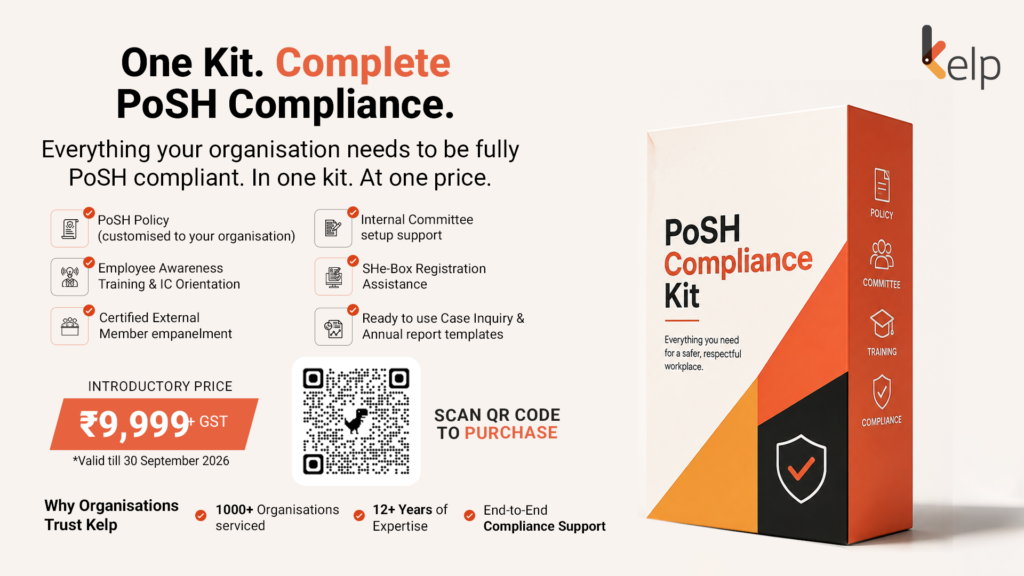
Ready-to-use PoSH Compliance Kit for MSME’s and smaller companies
If you’re a small organisation trying to implement PoSH compliance without an HR team or the necessary resources, we’ve made it simpler. Our PoSH Compliance Kit brings together everything you need in one ready-to-use package – so you can put the right processes in place without starting from scratch.
Get your PoSH Compliance Kit – Buy now
For more details and to speak to our team, connect with us at +91-95001-29652, email info@kelphr.com